Monday, June 11, 2007

Τετάρτη 13 Ιουνίου: Ο Βαρνάβας, η Εντβίντα, η μαϊμού και το μπογκομόλετς

The image “http://www.artic.edu/webspaces/siskelfilmcenter/2005/december/i/monroe/monkey_business_03.jpg” cannot be displayed, because it contains errors.

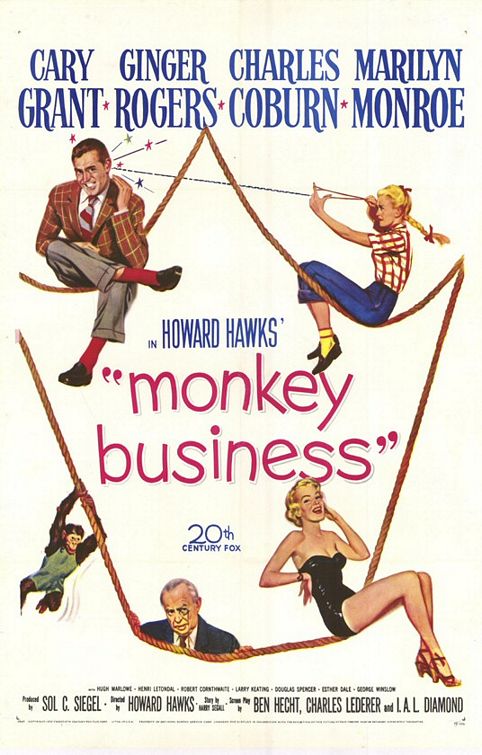
1952


Cary Grant - Ginger Rogers - Charles Coburn - Mairilyn Monroe

in

Howard Hawks

Monkey Business

The image “http://www.impawards.com/1952/posters/monkey_business.jpg” cannot be displayed, because it contains errors.

Perhaps the greatest Hollywood director who ever lived, Howard Hawks knew instinctively how to use certain actors. A year before he made his masterpiece Gentlemen Prefer Blondes, he made this superb comedy starring Cary Grant and Ginger Rogers with Marilyn Monroe in a scene-stealing supporting role that helped establish her screen persona for all time. Grant plays an absent-minded professor who stumbles upon a youth formula that restores vitality but causes you to act silly; both Grant and Rogers get a chance to go crazy. Monroe plays a sexy secretary who goes for a ride in Grant's snazzy new convertible and acts as the object of his desire for an afternoon. Filmmaker Jacques Rivette wrote a great essay about this film, discussing all its underlying Freudian implications, but it's also just great fun. Hawks' voice can be heard during the opening credits saying, "not yet Cary."

The image “http://www.stomptokyo.com/img-m2/monkeybiz-a.jpg” cannot be displayed, because it contains errors.

The image “http://www.stomptokyo.com/img-m2/monkeybiz-b.jpg” cannot be displayed, because it contains errors.


A film review by Christopher Null


Mr. Oxley's been complaining about her "punctuation," so she makes sure she's at her desk by nine. That's about the sum of Marilyn Monroe's contribution to Monkey Business, a screwball comedy (made about 10 years after the real end of the screwball era) featuring a kooky scientist, his patient wife, a brazen and dippy secretary, and of course a chimpanzee who's really calling the shots.

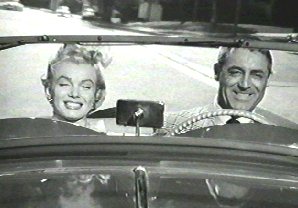
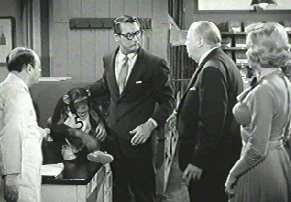
The plot involves the hunt for a youth formula by Barnaby Fulton (Cary Grant), which he thinks he has discovered when a self-administered sample drives him to do such crazy things as buy a new car and crash it into a chain link fence with his boss's secretary (Monroe) riding shotgun. The only problem is that the sample hasn't done anything; it's the water, spiked by the chimp when no one was looking.

Hijinks ensue when Fulton's wife (Ginger Rogers) gives it a try (thus putting a fish down the pants of Barnaby's boss). Eventually Barnaby overdoes it, turning into a real baby (or so his wife believes). Oh, the humanity!

Director Howard Hawks knows his way around the screwball, but Monkey Business pales next to his inimitable classics like His Girl Friday. At 41, Rogers was near retirement, and her antics recall Lucille Ball (and not really in a good way). Grant is as wonderful as ever, pulling the film along when its plot drags or his co-stars ham it up too much (which is pretty often). Altogether it's good fun -- good, but not great.

Featured as part of the restored set of Monroe classics in The Diamond Collection II (see links at right).

Sunday, May 20, 2007

Τετάρτη 23 Μαίου: Σινεμασόκ

1974

Νίκος Παναγιωτόπουλος


Αντιεπιστημονική φαντασία

σημειώσεις ενός φανατικού

Ανοίγω μια πόρτα. Σε ένα άδειο δωμάτιο ένας άνδρας φιλάει παράφορα μια γυναίκα με μακριά μαλλιά. Κρατάει στα χέρια του ένα όπλο. Την φιλάει και την σημαδεύει ταυτόχρονα. Δίπλα τους ένας κουβάς και μια σφουγγαρίστρα. Γυρίζω γύρω τους. Δεν φαίνονται να ενοχλούνται. Ακούγεται ένας πυροβολισμός. Ξυπνάω. Ο Φούλερ δεν είχε πει ότι ο κινηματογράφος είναι γυναίκες και όπλα; Προσπαθώ να ανοίξω τα μάτια μου. Κάνει ζέστη. Πόσο καιρό βρίσκομαι σ’ αυτό το κρεβάτι; Είμαι τόσο κουρασμένος. Χθες με ανάγκασαν να ανέβω τις σκάλες. Είναι όλοι τρελοί μέσα σ’ αυτό το σπίτι. Κι αυτό το καταραμένο ποντίκι δε λεει να μ’ αφήσει να ησυχάσω. Θέλω να κοιμηθώ. Μια γυναίκα μπαίνει στο δωμάτιο. Την βρίζω. Θέλει λεει να ανοίξει το παράθυρο να μπει λίγος αέρας. Γιατί δεν μ’ αφήνουν στην ησυχία μου. Ο κινηματογράφος είναι ένα ανοιχτό παράθυρο στον κόσμο.Της λεω να κλείσει αμέσως το παράθυρο. Με υπακούει και το κλείνει. Τα πάντα γίνονται ασπρόμαυρα. Βρέχει. Το ποδήλατο μου κυλάει σε μια κατηφόρα. Μια μπάντα παίζει ένα απόσπασμα από κάποια όπερα του Πουτσίνι. Με λένε Γιάννη. Απέναντι μου βρίσκεται μια γυναίκα. Την λένε Άννα. Με κοιτάει χωρίς να ξέρει τι θέλει να μου πει. Κι – νη – μα – το – γρά – φος. Μεγάλη λέξη. Όπως η λέξη σιδηρόδρομος ή όπως η λέξη φτουσκουλικομυρμηγκότρυπα. Άλλος ένας πυροβολισμός. Πέφτω νεκρός μέσα στο μπάνιο μου. Έπειτα σηκώνομαι και υποκλίνομαι. Ακούγονται χειροκροτήματα. Είναι επικύνδινο να δίνεις όπλα σε σκηνοθέτες. Όπως είναι επικύνδινο να δίνεις ένα βιζέρ σε ένα τροχονόμο. Προσπαθούν αμέσως να εγκλωβίσουν ανθρώπους μέσα σε κάδρα. Σαν αυτή τη γυναίκα με το κίτρινο αδιάβροχο. Διασχίζει ένα χωματόδρομο μέσα στη βροχή. Γύρω της είναι μια μεγάλη πεδιάδα κι όμως εκείνη προσπαθεί να διαφύγει μέσα από ένα ορθογώνιο παραλληλόγραμο. Προσπαθώ να μη στεναχωριέμαι. Είναι απλώς ένα όνειρο. Μου φαίνεται ότι όλα αυτά τα χρόνια πέρασαν σαν ένα όνειρο. Σαν μια αναμονή σε ένα αεροδρόμιο. Μια πτήση που καθυστερεί συνέχεια να έρθει. Ίσως είπια παραπάνω απ’ όσο έπρεπε. Που βρίσκομαι; Πόσα χρόνια πέρασαν; Τι έκανα όλα αυτά τα χρόνια; Μάλον ήμουν συνέχεια εδώ. Καθόμουν σ’ αυτήν την καρέκλα του αεροδρομίου. Πρέπει να αλλάζουμε για να μένουμε πάντα ίδιοι. Πρέπει να ξυπνήσω. Θα σταματήσω να πίνω. Θα σταματήσω και να καπνίζω. Θα ξυρίσω το κεφάλι μου. Ή μάλον θα πίνω τόσο πολύ ώστε να μη θυμάμαι τίποτε. Θα γίνω μια κατσαρίδα και θα μπω σ’ ένα βαζάκι μαρμελάδας bonne maman. Δεν μπορώ να παραμείνω ο αιώνιος σύζυγος. Ο κόσμος πρέπει να μάθει την ιστορία μου. Θα την στείλω σε αντίτυπα σε όλους για να καταλάβουν. Για να μάθουν. Η ιστορία μου πρέπει να γίνει γνωστή. Ακόμη κι αν χρειάζεται να αυτοπυρποληθώ. Να καώ. Αυτό που έχει τώρα σημασία είναι η ιστορία. Φτουξελευθερία. Θα μπω και θα ανακατευτώ με τον κόσμο. Θα ζήσω την νύχτα. Θα κυλιστώ στα σκυλάδικα. Αγαπώ τη Στέλλα και θα το φωνάξω. Είμαι φτιαγμένος για εκείνη και εκείνη μου ανήκει. Τώρα μπορεί να βλέπω τα αεροπλάνα να πετούν απ’ την ταράτσα αλλά έχω την Στέλλα. Στο μαγαζί έβαλα εφημερίδες και τσιγάρα.

Πέταξα και το μηχανάκι. Αγόρασα μια μηχανή κι αυτό αρέσει στη Στέλλα. Εκείνη δεν σκέφτεται πια να τραγουδίσει. Ίσως καμιά φορά που ακούει κάτι τραγούδια στο ραδιόφωνο και πιάνω το βλέμμα της να ξεφεύγει. Προς τα που άραγε; Άλλο ένα αεροπλάνο ακούγεται. Προσγειώνεται στο αεροδρόμιο της Μυκόνου. Ένα τζιπ φτάνει από μακριά. Με λένε Ανδρέα. Είμαι ο άνδρας της Ρέας και η Ρέα με περιφρονεί. Την βλέπω να χάνεται στο βάθος πάνω σ’ ένα μηχανάκι.

Τη φωνάζω αλλά δεν μ’ ακούει. Κάπου μακριά ακούγεται ο εθνικός ύμνος. Έπειτα ένας ακόμη πυροβολισμός. Νύχτα σε ένα αεροδρόμιο πάλι. Σκότωσα την γυναίκα. Γυναίκες και όπλα. Κινηματογράφος. Δεν θα ταξιδέψω. Σία Προδοσία. Δεν θα πετάξω. Θα μείνω σ’ αυτή την πόλη κι ίσως η πόλη με καταβροχθίσει στο τέλος. Ίσως όμως και να την εκδικιθώ. Ίσως πυροβολήσω την πόλη. Κατεβαίνω από το μηχανάκι μου. Σήμερα δεν θα παραδόσω καμιά πίτσα. Θα κοιτάξω την πόλη από ψηλά. Από κάπου ακούγεται μουσική. Μέσα σε ένα νοσοκομείο κάποιοι χορεύουν. Ξυπνάω αλλά ξέρω πως σύντομα θα ξανακοιμηθώ. Θα ανοίξω μια άλλη πόρτα. Μέχρι τότε θα προσπαθίσω να καταλάβω τι είδα και πως ξεκίνησαν όλα αυτά.

1. Μια συνέντευξη στο περιοδικό οθόνη, το τρόλεϊ δέκα και 4 βαλς του Σοπέν

Το τρόλεϊ δέκα έχει αφετηρία στη Σταδίου, πολύ κοντά στο Παλλάς. Κάθομαι σε μια απ’ τις τελευταίες θέσεις. Είμαι σχεδόν 15 χρονών και κοιτάω έξω το δρόμο. Μια κοπέλα, που αργότερα θ’ αποκτήσει ένα αντιπαθητικό σκυλί και θα παίξει σε διάφορες τηλεοπτικές σειρές, παίζει πιάνο μπροστά από έναν τοίχο. Ένα βαλς του Σοπέν. Έχω περπατήσει όλη την Αθήνα. Δεν μπορούσα να γυρίσω σπίτι κατευθείαν μετά την προβολή του Βαριετέ κι έκανα βόλτες. Περίμενα τόσο πολύ να δω αυτή την ταινία. Τι έχω πάθει; Αυτό πια καταντάει εμονή. Μεθαύριο θα έρθω να την ξαναδώ με μια φίλη μου. Αλλά σιγά να μην περιμένα δυο μέρες. Τον τελευταίο καιρό ζω σε ένα πυρετό περιμένοντας να βγει η ταινία. Λες και είναι δικιά μου. Όλα αυτά ξεκίνησαν όταν διάβασα μια συνέντευξη του Παναγιωτόπουλου για το Βαριετέ στο περιοδικό Οθόνη. Μέχρι εκείνη τη στιγμή δεν είχα ιδέα ποιος είναι. Από τότε όμως που διάβασα αυτή την συνέντευξη έγινα ένας φανατικός Παναγιωτοπουλικός. Αγάπησα με την μία όλες τις ταινίες που είχε κάνει και δεν είχα δει και όλες τις ταινίες που επρόκειτο να κάνει και δεν είχε ακόμη φανταστεί. Έψαχνα με μανία κάθε πληροφορία σε εφημερίδες και περιοδικά, ρώταγα δεξιά κι αριστερά, έκοβα αποκόματα και τα φύλαγα, κι όταν πια έμαθα πως η ταινία θα βγει στο Παλλάς έπαιρνα το δέκα από την Νέα Σμύρνη και ερχόμουν να χαζέψω την υπέροχη αφίσσα της ταινίας και μετά τις φωτογραφίες. Φανταζόμουν τις σκηνές κι έβλεπα στον ύπνο μου το Βαριετέ σε όλες τις πιθανές μορφές του. Τι υπέροχα όνειρα. Τώρα μόλις έχω δει την ταινία και δεν μπορώ να καταλάβω τίποτε. Στο μυαλό μου υπάρχουν μόνο εικόνες. Ο Γερμανός και ο Χρυσομάλης εκρεμείς σε μια ρόδα λούνα παρκ, ο Τσακίρογλου στα χιόνια να πετάει χρώματα, η Γερουλάνου σε ένα παράθυρο με φόντο το Σύνταγμα, η Λαζαρίδου με ένα περιοδικό μόδας στα χέρια μέσα σε ένα άδειο λευκό σπίτι και ο Βογιατζής με στολή τροχονόμου να κοιτάει από ένα βιζέρ. Ο οδηγός μπαίνει στο τρόλεϊ και διακόπτει τις σκέψεις μου. Το τρόλεϊ ξεκινάει. Ένας άνδρας τρέχει να το προλάβει. Δεν τα καταφέρνει και μένει στην στάση να το βλέπει να απομακρύνεται. Το Σάββατο που δεν έχω σχολείο να πάω ν’ αγοράσω τον δίσκο με τα βαλς του Σοπέν.

2. Η κομπίνα με τις κασέτες

Από την εποχή της πρώτης προβολής του Βαριετέ μέχρι σήμερα είδα όλες τις ταινίες του Παναγιωτόπουλου και παραμένω ένας φανατικός ότι και να κάνει. Το Βαριετέ το έχω δει από τότε πάρα πολλές φορές. Στην αρχή το ζητούσα στο Κέντρο αλλά δεν μου το δίνανε. Κι έτσι όσο ήμουν στη σχολή κινηματογράφου στις Βρυξέλες έβαλα κάτι καθηγητές μου να φτιάξουν ένα χαρτί που να το ζητάνε επίσημα από τη σχολή μαζί με μερικές άλλες αγαπημένες ταινίες. Μ’ αυτή την ιστορία κατάφερα να αποκτίσω μια κασέτα του Βαριετέ. Υποχρέωνα διάφορους φίλους να βλέπουν την ταινία και από τότε οι κινηματογραφόφιλοι στην Ελλάδα χωρίστηκαν για μένα σε δυο κατηγορίες, στους Παναγιωτοπουλικούς και στους άλλους. Οι πρώτοι ήταν οι φανατικοί με τους οποίους μοιραζόμασταν αναφορές, ατάκες και εικόνες και οι άλλοι ήταν αυτοί που έλεγαν το Βαριετέ, βαριέται, φώναζαν για γκονταρισμούς και ανεκδοτολογικά αστεία και γενικά δεν πέρνανε χαμπάρι. Το Βαριετέ παρέμεινε για μένα ως σήμερα η πιο αγαπημένη ταινία του Παναγιωτόπουλου. Ίσως γιατί είναι η πιο Παναγιωτοπουλική. Η πιο ελεύθερη. Μια ταινία φτιαγμένη από σκόρπιες σκέψεις, αναμνήσεις και συνειρμούς, αποσπάσματα από βιβλία, μουσικά μοτίβα ή επιθυμίες. Μια ταινία που βιώνει μια διπλή κρίση, καλλιτεχνική και προσωπική, μέσα σε μια κομψή μελαγχολία όπου ακόμη και το τραγικό παρασύρεται από ένα ελαφρό αεράκι. Από μια τρυφερή και γεμάτη αγάπη ειρωνία και όχι από έναν μίζερο κινυσμό. Το Βαριετέ είναι ένα φιλμ ποικιλιών που αν κλείσεις το ένα σου μάτι μπορείς να το δεις σε μια μεριά κι αν κλείσεις το άλλο μπορείς να το δεις κάπου αλλού. Όπως ακριβώς το κάνει ο Γερμανός ξαπλωμένος στον δερμάτινο καναπέ του γραφείου του. «Αν δεν μπορώ να συγκεντρώσω τα κομμάτια σε ένα σύνολο γεμάτο νόημα, τότε θα δείξω το κάθε κομμάτι όσο καλύτερα μπορώ», λεει ο Τσακίρογλου στην ταινία. Μια ταινία για μια κρίση δεν μπορεί παρά να είναι μια ταινία σε κρίση. Απελευθερωμένο από τα δεσμά της ιστορίας που, όπως γράφει ο Λιαρόπουλος στον οποίο είναι αφιερωμένη η ταινία, δεν μπορεί να έχει αρχή μέση και τέλος, το Βαριετέ δεν παρουσιάζει απλώς τα αποσπάσματα μιας ιστορίας όσο καλύτερα μπορεί. Τα τοποθετεί σε σχέσεις δημιουργώντας συνεχώς νέους συνειρμούς από την σύνδεση. Ο Γερμανός είναι στους γονείς του και τρώει. Δεν έχουν τι να πουν. Από μια τηλεόραση ακούγεται μια ταινία επιστημονικής φαντασίας. Ο Γερμανός προχωρά στην πόλη πλάτη στον φακό. Η ταινία συνεχίζει να ακούγεται δυνατά. Σαν να έχουν καταλάβει την πόλη τα διαστημόπλια. Υπέροχο πράγμα η σκέψη αλλά ακόμα πιο υπέροχη είναι η πε-ρι-πέ-τεί-α.

3. Το πλάνο; Ποιο πλάνο;

«Με συγχωρείτε...», λεει ο Σφήκας όταν καταλαβαίνει τι ενοούν αυτοί που του φωνάζουν ότι είναι μέσα στο πλάνο. Κρατάει μια διάφανη ομπρέλα. Γυρίζει από την άλλη και μπαίνει μέσα στη θάλασσα. Βυθίζεται στο νερό και μόνο η ομπρέλα του παραμένει. Ο μακινίστας Βαγγέλης Καζάν πετάει τα ρούχα του και βουτάει στην θάλασσα. Τον ακολουθεί ο ηλεκτρολόγος Γιώργος Διαλεγμένος. «Δεν είναι εδώ...δεν είναι πουθενά...εξαφανίστηκε!».

Τα χρώματα της ίριδας ήταν η δεύτερη ταινία του Παναγιωτόπουλου που είδα. Έκανε ένα αφιέρωμα η πανελλήνια ένωση κριτικών με τις δέκα καλύτερες ελληνικές ταινίες στο Έμπασυ. Τα χρώματα της ίριδας κατέλαβαν την πέμπτη θέση. Περίεργο για μια ταινία που δεν άρεσε στους κριτικούς όταν πρωτοβγήκε το 1975 μετά τη χούντα. Σε μια εποχή που αν δεν φορούσες αμπέχονο ή ταγάρι αν ήσουν κοπελιά, σε κοιτούσαν με μισό ματί σαν να ήσουν ύποπτος, οι περισσότεροι θεώρησαν τα χρώματα της ίριδας ύποπτα απολίτικης συμπεριφοράς. Κι έπειτα, ποιος είναι αυτός ο τύπος που ήρθε απ’ το Παρίσι και δηλώνει με θράσος ότι θέλει να κάνει ταινίες για το κέφι του! Πολλά πράγματα δεν πήγαιναν καλά με τα χρώματα της ίριδας. Πολλά πράγματα λείπανε. Εκτός από τα αμπέχωνα, τα ταγάρια και τις κοπελιές, δεν υπήρχαν ούτε υψωμένες γροθιές, ούτε σύμβολα, ούτε μυνήματα και κυρίως δεν υπήρχε ελληνικότητα. Ήταν φανερό, τα χρώματα της ίριδας δεν ήταν μια ταινία με νόημα. Τι ευτυχία. Μια ταινία που αναζητά το νόημα και τη φόρμα της παίζοντας το υπέροχο παιγνίδι του κινηματογράφου. Η προσπάθεια του μουσικού Νίκου Στρατή να εγκλωβίσει το νόημα μιας παράλογης πράξης μοιάζει με την προσπάθεια του κινηματογράφου να εγκλωβίσει την ζωή που συνεχώς διαφεύγει. Τα χρώματα της ίριδας διαφεύγουν συνεχώς ανάλογα με το κέφι του Παναγιωτόπουλου. Αυτές οι παρενθέσεις ή οι λοξοδρομίσεις δεν έχουν καμιά φανερή σχέση με το υπόλοιπο σώμα της ταινίας και δεν κρύβουν κανένα κρυφό νόημα. Τι νόημα έχει, για παράδειγμα, η σκηνή που ο Τσακίρογλου επισκέπτεται ένα δισκοπολείο και η ιδιοκτίτης του δείχνει έναν μουσάτο νεαρό λέγοντας του, «...τον Διονύση τον ξέρεις;». Η κάμερα κάνει ένα πανοραμίκ και εμφανίζεται ο Σαββόπουλος ενώ μπαίνει σχεδόν ολόκληρο ένα τραγούδι του. Θα μπορούσε κανείς να πει ότι επειδή το τραγούδι λεει, η οθόνη βουλιάζει σαλεύει το πλήθος, εικόνες ξεχύνονται κτλ. πρόκειται για μια ακόμη αναφορά στο θέμα του κινηματογράφου και της αναπαράστασης. Ίσως, αλλά τι μας νοιάζει κι όλας; Αυτό που μας νοιάζει είναι ότι το τραγούδι του Σαββόπουλου μπαίνει από το πουθενά, την ώρα που εκείνος στέκεται ακίνητος και αμήχανος. Είναι μια καθαρά ανόητη κατάσταση στην οποία δεν ξέρεις πως να αντιδράσεις. Είναι το παράλογο που τρυπώνει αναπάντεχα από το πουθενά σαν να βάζει μια μικρή βόμβα. Και η ταινία είναι γεμάτη από τέτοιοιους εξαίσιους πυροδοτικούς μηχανισμούς που μοιάζουν σαν να αντανακλούν ή και να ξεπερνούν την παράλογη εξαφάνιση του Σφήκα στην αρχή της ταινίας. Μια ηλιόλουστη μέρα ένας κύριος με μια ανοιχτή ομπρέλα συναντά έναν άλλο με μια κλειστή. Διασταυρώνονται, κοιτιούνται και ο ένας κλίνει την ανοιχτή ομπρέλα όσο ο άλλος ανοίγει την κλειστή. Ένας μουσικός παίζει ένα ρομαντικό θέμα στο φλάουτο ενώ δίπλα του η γυναίκα του χαμογελά καθαρίζοντας φρέσκα φασολάκια. Μια γυναίκα στα άσπρα εμφανίζεται σε κάτι σκάλες παράλληλα με μια μουσική. Μόλις η μουσική σταματά, η γυναίκα εξαφανίζεται. Σε ένα πάρτυ ξαφνικά η Πάολα αρχίζει να τραγουδά. Αυτή η αναρχική δύναμη της λοξοδρόμισης είναι που κάνει την ταινία στην ουσία της πολιτική. Γιατί ανατινάσει ταυτόχρονα την φόρμα και το περιοχόμενο με τρόπο αναπάντεχο, προκλητικό, αστείο και απολαυστικό. Και είναι αλήθεια ότι υπάρχει έλειψη ελληνικότητας για όσους θεωρούσαν ότι ελληνικότητα είναι μόνο τα ακροκέραμα και η λαϊκή μας παράδοση. Δεν πειράζει. Έχει μέσα της, τόση πολύ αθηναϊκότητα που μας αρκεί και με το παραπάνω. Και γι’ αυτόν επίσης τον λόγο, τα χρώματα της ίριδας σαν μια γνήσια ταινία πόλης, είναι μια πολιτική ταινία. Άλωστε όσοι κινηματογραφιστές επαναστατικοποίησαν τον κινηματογράφο και δεν έκαναν απλά τις εικόνες μιας επανάστασης, κατέβηκαν πρώτα απ’ όλα να φίλμαρουν την πόλη τους. Τα χρώματα της ίριδας λοιπόν είναι όπως λέει ο Παναγιωτόπουλος μια ταινία ενός νέου είδους, της αντιεπιστημονικής φαντασίας, και ενός καινούριου φορμά, του σινεμά-σοκ. Τι σημαίνει αυτό δεν έχω ίδεα. Το πιθανότερο τίποτε.

4. Ένα κλειστό παράθυρο στον κόσμο. Ασπρόμαυρο.

Το 1985 η πολιτιστική πρωτεύουσα της Ευρώπης, Αθήνα μου έκανε ένα αναπάντεχο δώρο. Στα πλαίσια κάποιων εκδηλώσεων προγραμάτισε τους τεμπέλιδες της έφορης κοιλάδας και το Μελόδραμα. Πάλι στο Παλάς νομίζω. Το τρόλεϊ δέκα έκανε και πάλι τη δουλειά του. Μόνο που η προβολή των τεμπέλιδων ακυρώθηκε για τεχνικούς λόγους... τρέχα γύρευε. Απίστευτη απογοήτευση. Προσπαθούσα να εξηγήσω στον κύριο στην πόρτα ότι δεν ήταν δυνατόν να μας το κάνουν αυτό αλλά δεν έδειχνε να με καταλαβαίνει. Έτσι κι αλλιώς δεν ήταν δική του ευθύνη. Τουλάχιστον υπήρχε η αφίσσα να χαζεύω περιμένοντας για το Μελόδραμα μερικές μέρες μετά.

Τι παράξενη ταινία. Πόσο διαφορετική από το Βαριετέ και τα Χρώματα της ίριδας. Προσπαθώ να καταλάβω που πατάει αυτή η ταινία και έχω την εντύπωση πως βρίσκεται μέσα σε ένα κενό χώρο. Σαν αυτό να είναι το θέμα της. Κι όμως υπάρχουν όλα τα στοιχεία του μελοδράματος. Ο έρωτας, η νοσταλγία, η επιστροφή, ο χωρισμός και ένας φόνος. Υπάρχει επίσης ο Βέρντι και ο Πουτσίνι. Υπάρχει η βροχή που μοιάζει να σε διαπερνάει. Και αυτό το υπέροχο ασπρόμαυρο του δειλινού. Όλα αυτά δεν συνιστούν ένα μελόδραμα; Δυο πρόσωπα πίσω από ένα βροχερό παράθυρο δεν αποτελούν μια εικόνα ενός μελοδράματος; Όχι. Όλα αυτά είναι εκεί για να καταδείξουν την απουσία του μελοδράματος. Την αποχή των συναισθημάτων. Αυτό που βλέπουμε είναι μόνο ότι υπάρχει ανάμεσα στα ίχνη της μελοδραματικής ιστορίας. Δηλαδή το κενό. Ο Γιάννης και η Άννα ζουν σε ένα κενό χώρο. Αυτό που κάνει η σκηνοθεσία είναι μόνο να αφαιρεί κάθε πιθανότητα έκφρασης από τα πρόσωπα και να μεταβιβάζει συνεχώς στον χώρο τις σκέψεις, τις μνήμες ή τα συναισθήματα. Μοιάζει η Κέρκυρα να βουλιάζει μέσα τους. Κι αν στα αποσπάσματα απ’ τις όπερες που ακούει ο Γιάννης τραγικές γυναίκες και ρομαντικοί άνδρες εκφράζουν το πάθος τους, στην πραγματική του ζωή εκείνος δεν είναι ικανός να εκφράσει τίποτε. Το ίδιο και εκείνη. Εκεί βρίσκεται το δικό τους τραγικό. Η Άννα υπομένει στωικά να τελειώσει το μάθημα ενός άχαρου βιολιού που είναι σαν να ξύνει συνέχεια μια πληγή. Ο Γιάννης ακούει τα αγκομαχητά της άρωστης μητέρας του. Μοιάζουν και οι δυο να μην νοιώθουν τίποτε. Ακόμη και η ένωση τους είναι απελπισμένη. Μια ερωτική πράξη ανάμεσα σε δυο άψυχα σώματα εραστών. Τόσο σκληρή αυτή η σκηνή. Είχε δίκιο ο Ραφαηλίδης που έγραφε πως πρόκειται σχεδόν για μια ταινία φρίκης.

5. Από που έρχεται αυτή η μουσική;

Μετά το Βαριετέ περίμενα με απίστευτη περιέργεια ποια θα είναι η καινούρια ταινία του Παναγιωτόπουλου. Εκνευριζόμουν που γυρνάει τόσο αραιά τις ταινίες του. Μα επιτέλους τι κάνει; Κάποια στιγμή διάβασα σε μια εφημερίδα ότι ετοιμάζει μια ταινία επιστημονικής φαντασίας με τίτλο Η κοιλάδα των ρόδων. Από τότε κοίταζα όλες τις εφημερίδες να βρω κάποια πληροφορία αλλά τίποτε. Κάποια στιγμή βρήκα τυχαία στην βιβλιοθήκη του σχολείου μου το βιβλίο του Παύλου Ντήναχ και το δανείστηκα. Τελικά δεν το επέστρεψα ποτέ. Μα ήταν ποτέ δυνατό να γίνει αυτό το έπος ταινία; Μετά από καιρό διάβασα κάπου αλλού ότι ο Παναγιωτόπουλος ετοιμάζει μια ταινία που λέγεται Η γυναίκα που έβλεπε τα όνειρα. Περίεργος τίτλος. Μια μέρα κατάφερα να κάνω κοπάνα απ’ το σχολείο και να παω σε ένα γύρισμα που έμαθα ότι θα γινόταν. Ήταν μια σκηνή στο θέατρο. Είχα κρυφτεί πίσω από κάτι κολώνες και παρακολουθούσα. Φοβόμουν τρομερά μη με ανακαλύψουν μέσα στο σκοτάδι κι έτσι έφυγα γρήγορα.

Δεν μπόρεσα να δω τελικά την γυναίκα που έβλεπε τα όνειρα σε αίθουσα γιατί ήμουν στις Βρυξέλες. Ξεκίναγα την σχολή. Ευτυχώς την είδα σε κασσέτα στο Κέντρο. Είχα πει ότι κάνω μια εργασία για τον Παναγιωτόπουλο κι έτσι με αφήσαν να την δω εκεί και να κρατήσω σημειώσεις αν θέλω. Δεν κράτησα φυσικά καμιά σημείωση. Η γυναίκα που έβλεπε τα όνειρα είναι μια κωμωδία λέει ο Παναγιωτόπουλος. Μια κωμωδία με την ένοια που ο Τσέχωφ ονόμαζε τα έργα του κωμωδίες. Μια κομεντί σαν αυτές του Λιούμπιτς ή του Χοκς. Η ιδέα της ταινίας είναι πέρα για πέρα Παναγιωτοπουλική. Αυτό που ενδιέφερε πάντα τον Παναγιωτόπουλο ήταν οι ρωγμές της πραγματικότητας. Οι τρύπες και τα χάσματα. Τα σημεία δηλαδή εκείνα από όπου κάτι αναπάντεχο μπορεί να διυσδίσει ή να διαφύγει. Εδώ, τα χάσματα γίνονται το βασικό θέμα της ταινίας. Τα όνειρα που βλέπει η Άννα γίνονται αφορμή για μια κρίση στην σχέση της. Αυτές οι μικρές εκρήξεις ανόητου αποτελούν τον αυστηρά ιδιωτικό της χώρο που επιθυμεί να μοιραστεί με τον άντρα της τον Αχιλλέα. Το να μοιραστεί τα όνειρα της αποτελεί για εκείνη την ουσία της επικοινωνίας. Είναι σαν να παράγει μικρά αυτόνομα έργα που θα ήθελε να τα δείξει και σε έναν ακόμη θεατή. Έργα ιδανικά μια και απελευθερωμένα πλήρως από την συνέχεια ή το νόημα αποτελούν οάσεις των αισθήσεων. Τα όνειρα είναι μια ακόμη μεταμφίεση του κινηματογράφου. Αυτό είναι κάτι που τρομάζει την Άννα. Ένας εφιάλτης που επανέρχεται και αποτελεί βασικό μοτίβο της ταινίας είναι ο εγκλωβισμός της σε ένα ορθογώνιο παραλληλόγραμμο που την κυνηγάει και δεν την αφήνει ποτέ να βγει εκτός κάδρου. Ο άντρας της ο Αχιλλέας δεν μπορεί να το καταλάβει αυτό. «Βλέπεις εσύ κανένα ορθογώνιο παραλληλόγραμμο;» επιμένει, την στιγμή που η κάμερα με τον ίδιο τρόπο τον εγκλωβίζει και δεν τον αφήνει να βγει εκτός κάδρου. Εκείνος, σαν δικηγόρος, πατάει στέρεα στην πραγματικότητα. Στην αρχή βρίσκει χαριτωμένη την μικρή αυτή ιδιοτροπία της γυναίκας του αλλά στην συνέχεια τον κουράζει, τον εξαντλεί. Αυτό που δεν μπορεί να δεχθεί είναι η παντελής έλειψη συμπαγούς νοήματος. Το ανόητο τον εξοργίζει. «Είναι μια τρέλλα...» λεει σε ένα φίλο του, «...μια ακρότητα. Δεν μπορώ να το πολεμήσω λογικά». Ο φίλος του κρατάει ένα μικρό λευκό μπαλόνι, του το πετάει και όσο μιλούν παίζουν. «Και η λογική είναι μια ακρότητα», του απαντά. Η Άννα έχει αποφασίσει να μην του διηγηθεί πια κάνενα όνειρο, και εκείνος έχει αρχίσει να την υποπτεύεται. Η κρίση στο ζευγάρι ξεπηδά από μια ρωγμή που δεν ξέρουν πως να την διαχειρισθούν και κλείνει με μια σύμβαση. Ένα ψέμα. Η Άννα καταλαβαίνει πως δεν χρειάζεται να επικοινωνεί τα όνειρα της κι έτσι του λεει πως δεν ονειρεύεται πια. Η σχέση διασώζεται από ένα ψέμα. Μια πράξη ώριμη. Μια σύμβαση στην ουσία της επαναστατική. Αυτός που έχει βοηθήσει την Άννα να καταλάβει είναι άλωστε ένας επαναστάτης θείος. Μια φιγούρα που θυμίζει τον Πάμπλο. «Η δυστυχία είναι αντιεπαναστατική», της λεει ο ογδοντάρης θείος που αντί να βάζει πια βόμβες, βάζει μουσική. Το πρώτο κοντσέρτο του Μπραμς φυτρώνει αναπάντεχα μέσα σε επίσημες συνεδριάσεις, σε δημόσιους χώρους ή σε αίθουσες δικαστηρίων. Η επαναστατικότητα της δικής του πράξης του είναι μια ακόμη ρωγμή στην πραγματικότητα.

6. Μια μεγάλη παρεξήγηση

Περίμενα πολύ καιρό μέχρι να δω τους τεμπέληδες της έφορης κοιλάδας. Ήταν η μόνη ταινία που μου έλειπε. Θυμαμαι ζήλευα τρομερά μια φίλη μου στις Βρυξέλες που την είχε πετύχει σε ένα ολλανδικό κανάλι. Εντωμεταξεί διάβαζα διάφορα κείμενα για την ταινία σε περιοδικά τις εποχής ή έβαζα ανθρώπους που την είχαν δει, να μου την περιγράψουν. Ο καθένας μου έλεγε και κάτι διαφορετικό. Είδα τελικά την ταινία για πρώτη φορά στην τηλεόραση. Όλα γύρω απ’ αυτή την ταινία είναι μια μεγάλη παρεξήγηση. Η κατεύθυνση της ερμηνείας που διοχέτευσε ο ίδιος ο Παναγιωτόπουλος στην αρχή ήταν καθαρά πολιτική. Μια παραβολή για τον θάνατο της αστικής τάξης. Η ταινία έκοψε έναν υπερβολικά μεγάλο αριθμό εισιτηρίων. Περίπου 120.000. Ο κόσμος πήγε πολύ πιθανόν να την δει για την φήμη των τολμηρών ερωτικών σκηνών. Οι περισσότεροι έφευγαν βρίζοντας. Οι κριτικές ήταν διθυραμβικές και η ταινία απέσπασε μεταξύ άλλων το χρυσό βραβείο στο φεστιβάλ του Λοκάρνο. Πολλοί μιλάγανε για μια ταινία στα χνάρια του Grand bouffe. Η μοναδική σχέση όμως που έχει η ταινία του Φερέρι με τους τεμπέληδες της έφορης κοιλάδας είναι ότι στην μια ταινία τρώνε και στην άλλη κοιμούνται. Αν σε όλες τις ταινίες του Παναγιωτόπουλου υπάρχουν τρύπες και χάσματα, εδώ αυτό που διαφεύγει είναι το ίδιο το νόημα.

Στο μυθηστόρημα του Cossery απ’ το οποίο έχουν εμπνευστεί το σενάριο οι τεμπέληδες της έφορης κοιλάδας, ο ύπνος είναι μια απόκτηση. Ένα είδος νιρβάνας που καταφέρουν να αποκτήσουν οι ήρωες. Μια ωριμότητα. Στην ταινία του Παναγιωτόπουλου, ο σκοπός της οικογένειας ο ύπνος. Κάθε τι που μπορεί να διαταράξει την ησυχία των μελών της εκλαμβάνεται σαν απειλή. Οι παραδοσιακές αστικές αξίες όπως οι σπουδές, η εργασία ή ο γάμος, αποκτούν διαστάσεις επανάστασης. Ο στόχος είναι να μην αλλάζει τίποτε. Να παραμένουν τα πάντα ως έχουν. Η αδράνεια οδηγεί νομοτελειακά στην σήψη. Είναι εξαιρετικά λογικά αυτά που λεει ο πατέρας των τεμπέληδων. Δεν υπάρχει κανένας λόγος να χαλάει κανείς της ησυχία του. Κι έτσι ο πατέρας και οι τρεις γιοι βυθίζονται σιγά σιγά στην αγκαλιά του ύπνου. Ο Παναγιωτόπουλος δεν αντιστρέφει μόνο τους αστικούς κώδικες της ηθικής αλλά και του ίδιου του κινηματογράφου.

Η ταινία έχει μια αντίστροφη εξέλιξη. Η κορύφωση της είναι η απόλυτη αδράνεια. Ο θάνατος. Οι ρυθμοί της γίνονται όλο και πιο βραδείς. Η οικογένεια που στην αρχή έχει ανάγκες, βγαίνει, τρώει, κάνει έρωτα όσο περνάει ο καιρός αποκόπτεται από κάθε άλλη φυσική λειτουργεία για να μπει στον λίθαργο. Ο Παναγιωτόπουλος έχει καταφέρει το αδύνατο. Να δημιουργήσει σασπένς γύρω από ανθρώπους που κοιμούνται. Και η παραμικρή λεπτομέρεια αποκτά γιγαντιαίες διαστάσεις. Δεν είναι μόνο η δεξιοτεχνία της σκηνοθεσίας που διαστέλει τους χώρους μέσα από μια χορογραφία κινήσεων και όλοι αναφέρουν σαν το μεγάλο προτέρημα της ταινίας, είναι εξ’ ίσου και το σενάριο που μέσα από μια αριστοτεχνική οργάνωση ελείψεων μας δίνει τα σημάδια του χρόνου που κυλά. Το πράσινο της εξωτερικής φύσης εισβάλει σταδιακά στο εσωτερικό του σπιτιού και γίνεται το χρώμα της μούχλας. Τα πρόσωπα και οι χώροι χάνουν σιγά σιγά τα χρώματα τους. Η εικόνα αποκτά ζεστούς τόνους μόνο στην τελευταία σκηνή της προσπάθειας απόδρασης από το σπίτι. Είναι τα χρώματα της δύσης που κοκκινίζουν το τοπίο. Καθώς ο νεότερος αδερφός θα αποκοιμηθεί ακόμη μια φορά, αποκαμομένος από την προσπάθεια, στην αγκαλιά της ερωμένης υπηρέτριας του.

7. This is a blackout

Ονειρεύομαι τους φίλους μου. Τι υπέροχος τίτλος. Τι υπέροχη ταινία. Μαζί με το Βαριετέ είναι δυο πιο αγαπημένες μου. Την είδα στο Αττικόν με δυο παναγιωτοπουλικούς φίλους μου. Βγήκαμε στη Σταδίου και είχαμε το ίδιο συναίσθημα. Μια απροσδιόριστη αίσθηση αιώρησης. Σαν να βρισκόμασταν στο κενό. Αυτή η ταινία είναι ένα όριο στον κινηματογράφο του Παναγιωτόπουλου. Αποτελεί την τελευταία ταινία μιας περιόδου. Άλωστε, όπως έλεγε η αφίσσα είναι το road movie μιας γεννιάς. Από το 60 μέχρι το 90, τέσσερεις ιστορίες για τέσσερεις δεκαετίες σε τέσσερεις εποχές του χρόνου. Σημειώσεις για έναν απολογισμό που δεν έγινε ποτέ. Ψίγματα ιστοριών και ίχνη της κάθε εποχής. Μινιμαλισμός.

Το ονειρεύομαι τους φίλους μου μοιάζει με το Μελόδραμα. Έχουν την ίδια απόγνωση και την ίδια λιτότητα. Μιλούν και τα δυο για το κενό της ύπαρξης ή της επικοινωνίας. Όλα όσα πρέπει να λεχθούν κρύβονται ή αποσιωπούνται. Το τοπίο και πάλι αποροφά τα συναισθήματα των ηρώων και τα αντανακλά σε αισθήσεις. Ένας ποδηλάτης που κινείται αργά μπροστά από ένα κόκκινο κτίριο. Το χάραμα σε ένα λιβάδι δίπλα στην εθνική. Τα αεροπλάνα που ακούγονται να φεύγουν μέσα σε ένα αεροδρόμιο με blackout. Ένα βαλς του Στράους και ένα κομμάτι του Ντίζι Γκιλέσπι.

Η ταινία ξεκινά την άνοιξη του 1965 στο Βερολίνο. Ο Βογιατζής βγαίνει από μια σοφίτα σε μια στέγη. Φοράει μαύρα γυαλιά. Κοιτάει τον ουρανό του Βερολίνου κι έπειτα ξαναμπαίνει μέσα. Από κάπου μακριά ακούγεται ένα γερμανικό τραγούδι του 60. Σε όλο αυτό το πρώτο επεισόδιο του Βερολίνου ο Βογιατζής δεν θα βγάλει ποτέ τα μαύρα γυαλιά του. Μοιάζεις με κατάσκοπο, του λεει ένας αμερικάνος φρουρός. Μιλάει ελάχιστα. Παρατηρεί τα πάντα χωρίς να είναι πραγματικά εκεί. Δεν συμμετέχει σε τίποτε. Είναι ένας ξένος. Την μοναδική φορά που μιλάει είναι για να πει μια παιδική ανάμνηση από την Ελλάδα. Αυτό το συναίσθημα της αποχής από τα πράγματα, της ζωής που βρίσκεται κάπου αλλού επιτείνεται από την συνεχή παρουσία των τρένων ή των τραμ που μοιάζουν να πέρνουν μαζί τους την νοσταλγία για έναν άλλο χώρο που εδώ είναι η Ελλάδα. Όλη η εποχή περνάει μέσα από λεπτομέρειες. Τα έντονα χρώματα των ντεκόρ, ροζ, κόκκινα, μπλε και κίτρινα, μερικά τραγούδια ή το πρόγραμμα των κινηματογράφων.

Στο δεύτερο επεισόδειο, το καλοκαίρι του 1973 βρισκόμαστε σε μια νταλίκα στην Εθνική που από την Γιουγκοσλαβία πηγαίνει στην Θεσσαλονίκη. Μια μεγάλη διαδρομή. Μια ατέλειωτη ευθεία. Ο Κυριάκος, εδώ για πρώτη φορά μαθαίνουμε το όνομα του, θέλει να κοιμηθεί, ο οδηγός όμως τον έχει πάρει μαζί του για παρέα και θέλει να μιλάνε. Εκείνος όμως δεν είναι ικανός για πολλά λόγια. Μπορεί μόνο να ακούει και να συμφωνεί για να αποφύγει την συζήτηση. Η νεοελληνική σχιζοφρένεια είναι παρούσα στο πρόσωπο του οδηγού. Από την μια η Ελλάδα είναι η καλύτερη χώρα, η καλύτερη θάλασσα, το καλύτερο φαγητό, οι καλύτεροι άνθρωποι, όλα τα καλύτερα, και μετά από λίγο η Ελλάδα είναι ένας κωλότοπος που πρέπει να του δώσουμε μια κλωτσιά για να παει μια και καλή στα κομμάτια. Παρ’ όλη το μονόλογο του η ώρα δεν περνάει με τιποτε. Ο οδηγός του ζητάει να του πει μια αληθινή ιστορία. Κάτι που να του έχει συμβεί και να ντρέπεται να το ομολογήσει ακόμη και στον ίδιο του τον εαυτό. Ο Κυριάκος όμως δεν έχει να πει μια δικιά του ιστορία. Λεει την ιστορία κάποιου άλλου. Ένα έγκλημα. Ένας άνδρας που πνίγει την ερωμένη του γιατί και αυτός πνίγεται από κάτι άλλο. Κάτι πιο μεγάλο.

Εδώ βρίσκεται ίσως όλο το συναίσθημα μιας εποχής. Σε αυτή την εξομολόγηση που δεν θα μάθουμε ποτέ αν είναι μια προσωπική ιστορία του Κυριάκου ή κάτι που έχει επινοήσει. Ο οδηγός θα τον αφήσει στην μέση της διαδρομής. Μέσα στο χάραμα εκείνος μόνος του. Πάλι σε ένα πουθενά. Στην μέση ενός ατέλειοτου δρόμου. Ο Κυριάκος κοιτάει μπρος και πίσω του. Από μακριά ακούγεται πάλι ένα τρένο που περνάει.

Η τρίτη ιστορία συμβαίνει το φθινόπωρο του 1981 στην Ελλάδα πάλι σε ένα πουθενά. Μέσα στην αίθουσα αναμονής ενός αεροδρομίου που έχει πάθει blackout. Εδώ μαθαίνουμε πως ο Κυριάκος είναι συγγραφέας ή δημοσιογράφος. Δεν περιμένει κανένα και δεν πρόκειται να πάει πουθενά. Απλώς πίνει. Πίνει τόσο πολύ που δεν βλέπει μπροστά του. Κάθεται στο μπαρ του αεροδρομίου και σιγά σιγά καταρέει. Αποφεύγει και πάλι τις ερωτήσεις. Κρύβεται στο σκοτάδι. Εδώ είσαι; Τον ρωτάει ο μπάρμαν, απάντησε μου ρε γαμώτο και σταμάτα να μετακινείσαι, μην αλλάζεις διαρκώς θέσεις. Αυτή είναι όμως η εποχή. Αν το 73 ένοιωθες κάτι μεγαλύτερο να σε σφίγγει, το 81 πρέπει να μετακινείσαι διαρκώς. Ο Κυριάκος καταρέει. Πέφτει κάτω και ένας άστυνόμος τον μαζεύει. Με την βοήθεια του μπάρμαν τον τοποθετούν σε μια καρέκλα. Τα φώτα ανάβουν και μια αναχώριση ανακοινώνεται από τα μεγάφωνα. Εκείνος χαμογελάει με κλειστά μάτια. Ίσως να ονειρεύεται ένα ακόμη αλλού.

Χειμώνας του 1990. Το τελευταίο επεισόδιο διαδραματίζεται στις μαρμάρινες τουαλέτες της Μεγάλης Βρεταννίας. Το αλλού έχει γίνει πια εδώ. Και αυτό το εδώ μοιάζει με ένα πολυτελές τάφο. Οι τρεις φίλοι που κατεβαίνουν να κάνουν ένα γάρο κρυφά βρίσκονται πια στις θέσεις τους. Ο ένας απ’ αυτούς παντρεύει τον γιο του και δίνει μια μεγάλη δεξίωση. Κανείς δεν ονειρεύεται πια. Είναι και οι τρεις πάρα πολύ βαρείς για οτιδήποτε. Το μόνο που μπορούν είναι να πληγώνουν ο ένας τον άλλον. Μοιάζουν με τρία γέρικα ζώα κάτω απ’ το φράκο τους. Κλάνουν και ρεύονται, μιλάνε για κοψίδια, γαρδούμπες και αμελέτητα, ιδρώνουν, και έχουν συχνοουρία ή καούρες. Είναι κυνικοί και κατεστραμένοι. Για έναν απ’ αυτούς η μαρμάρινη τουαλέτα θα γίνει ο πραγματικός τάφος του. Οι άλλοι στην αρχή δεν τον πιστεύουν. Όμως ακόμη κι όταν επιβεβαιώνουν τον θάνατο δεν θέλουν να μπλέξουν. Δεν νομίζω να χρειάζεται να πούμε..., λέει ο ένας. Τι να πούμε τζον; Κι εμείς έτσι τον βρήκαμε, λεει ο Κυριάκος. Τον αφήνουν νεκρό και αποχωρούν. Αν οι προηγούμενες ιστορίες ήταν χτισμένες πάνω στο κενό και το τίποτε, σε αυτήν την τελευταία το τίποτε είναι πραγματικά τίποτε. Το Ονειρεύομαι τους φίλους μου έκοψε, όπως ήταν φυσικό, ελάχιστά εισητίρια. Ήταν η αφορμή για μια στροφή στο έργο του Παναγιωτόπουλου.

8. Τα χρώματα της ίριδας νούμερο 2 / Classique = moderne

Ο θείος Γκοντάρ έλεγε ότι το κλασικό ισούται με το μοντέρνο. Ο Παναγιωτόπουλος σαν γνήσιος γκονταρικός επιχειρεί από τον Εργένη και μετά αυτό το πάντρεμα. Επιχειρεί δηλαδή το πιο δύσκολο απ’ όλα. Το να μπορούν οι ταινίες να επικοινωνούν με το κοινό είναι ένα αίτημα που απαιτεί μια γεναιοδωρία από την μεριά του καλλιτέχνη και πόσο μάλον από την μεριά ενός καλλιτέχνη σαν τον Παναγιωτόπουλο. Ο Εργένης είναι λοιπόν μια νέα αρχή και δεν είναι τυχαίο ότι ο ίδιος την θεωρεί κάτι σαν τα χρώματα της ίριδας νούμερο 2.

Αυτήν την περίοδο, λίγους μήνες πριν από την προβολή του Εργένη, ήταν που γνώρισα για πρώτη φορά τον Παναγιωτόπουλο. Είχαμε κάνει μαζί με τον Στρατή Βουγιούκα μια Γκονταρικοπαναγιωτοπουλική μικρού μήκους που είχε διάφορες αναφορές στα χρώματα της ίριδας και πήγαμε, ντροπαλοί και κολομένοι, να του τη δείξουμε.Η προβολή επέτυχε. Εμείς ενθουσιαστήκαμε, και έτσι ξεκίνησε μια γνωριμία που εξελήχθηκε σε μια φιλία.

Είδα τον Εργένη για πρώτη φορά σε μια απ’ τις πρεμιέρες. Υπήρχε ήδη αρκετός θόρυβος γύρω από την ταινία λόγω του σκανδάλου με τη Ματσάγγου αλλά και λόγω των ηχηρών πρωταγωνιστών. Ομολογώ ότι βγήκα απ’ την πρεμιέρα χωρίς να ξέρω τι να πω. Δεν μου φαινόταν σαν να είχα δει μια ταινία του Παναγιωτόπουλου. Που είχαν πάει τα μακρινά τράβελιγκ, οι νωχελικοί ρυθμοί, η λεπτή ειρωνία και οι αγαπημένες παράξενες λεπτομέρειες; Έμοιαζαν σαν όλα να ήταν φτιαγμένα με γραμμές πολύ πιο αδρές, σαν να είχε χαθεί η λεπτότητα και η χάρη της κινηματογράφισης. Μετά από μια δυο βδομάδες ξαναείδα την ταινία σε μια ασφυκτικά γεμάτη αίθουσα μαζί με κάτι φίλους που τους άρεσε πολύ. Εγώ ήμουν σκεπτικός, όμως πολύ πιο γοητευμένος από την ταινία. Τώρα καταλάβαινα ότι το ζήτημα ήταν κάτι άλλο. Ο Εργένης ήταν μια ταινία pop. Το μυθηστόρημα του Ραπτόπουλου ήταν ιδανικό για κάτι τέτοιο. Ένα φιλμ εμπνευσμένο από τα αστυνομικά κόμικς που μέσα του υπήρχε εξ’ ίσου, ο αιώνιος σύζηγος του Ντοστογιέφσκι και το Pulp Fiction του Ταραντίνο. Βρήκα μερικές μέρες μετά τον Παναγιωτόπουλο στο σπίτι του και κάναμε μια συζήτηση για την ταινία που δημοσιεύθηκε στη βαβέλ και εικονογραφήθηκε μόνο από pop art έργα. Από αυτή την συζήτηση προέκυψαν μερικές σκέψεις:

- Ο Εργένης είναι μια πολιτική ταινία που μιλάει για έναν ρομαντικό ήρωα, βγαλμένο από την παράδοση των μυθηστορημάτων του 19ου αιώνα. Απέναντι σε μια κοινωνία γενικευμένης εκπόρνευσης αποφασίζει να κάνει μια πράξη καταστροφής που είναι ταυτόχρονα και μια πράξη θυσίας. Η ιστορία του θέλει να γίνει παράδειγμα, γι αυτό και την αποστέλει σε όσους περισσότερους παραλήπτες.

- Είναι μια ταινία που μιλάει για την πτώση ενός άνδρα από τον ουρανοξύστη στο υπόγειο.

- Ο ήρωας της ταινίας προσπαθεί να γίνει όσο πιο βρώμικος και απεχθής μπορεί. Απέναντι σε μια illustration εποχή που κυριαρχείται από διαφημίσεις, σαχλές τηλεοπτικές εκπομπές και life style έντυπα, μεταμορφώνεται σταδιακά σε μια κατσαρίδα γιατί όλη η κοινωνία είναι με ένα πράσινο Baygon στο χέρι. Ακόμη όμως κι η κατσαρίδα γίνεται τελικά ένα κατοικίδιο που μπαίνει μέσα σ’ ένα βαζάκι μαρμελάδας bonne maman. Γι αυτό δεν της μένει καμιά άλλη λύση. Η κατσαρίδα αυτοπυρπολείται.

- Η ταινία είναι μια παιγνιώδης παρωδία που όπως η pop art, δανείζεται στοιχεία από την διαφήμηση, το λαϊκό κόμικ και κάθε τι το καταναλωτικό για να τους αλλάξει την υπόσταση και να τα μεταθέσει σε μια σχεδόν κλασική φόρμα.

- Ο Παναγιωτόπουλος που μέχρι τώρα δήλωνε ότι είναι ένας ερασιτέχνης κινηματογραφιστής που μέσα στην λέξη ερασιτέχνης έβρισκε την λέξη εραστής και την λέξη τέχνη, τώρα δηλώνει ότι όσο μεγαλώνει βλέπει ότι και μέσα στην λέξη επαγγελαμτίας υπάρχει η λέξη άγγελμα ή άγγελος. Σαν τον ήρωα της ταινίας του, έχει ανάγκη να επικοινωνήσει την ιστορία του. Να την διαδόσει. Θυσιάζει ένα κομμάτι του κινηματογράφου του αλλά όπως λεει ο ίδιος, πρέπει να αλλάζουμε για να μένουμε πάντα ίδιοι.

9. Όμορφα παιδιά! Η περιπέτεια πέθανε

Αν ο Εργένης είναι μια ταινία pop η επιθυμία για το Αυτή η νύχτα μένει είναι να γίνει μια λαϊκή ταινία. Και αν το Μελόδραμα ξεκινούσε με ένα παράθυρο που κλείνει σαν ένα ειρωνικό σχόλιο στο τσιτάτο του Μπαζέν «ο κινηματογράφος είναι ένα ανοιχτό παράθυρο στον κόσμο», στο Αυτή η νύχτα μένει, η ταινία ξεκινάει με ένα παράθυρο που ανοίγει και μια τραγουδίστρια που κάνει πρόβες σε ένα λαϊκό τραγούδι μέσα σε ένα σπίτι χτισμένο πάνω απ’ τις γραμμές του τρένου.

Από αυτήν την ταινία κι έπειτα, παρακολούθησα από κοντά την γέννηση και την πραγματοποίηση κάθε ταινίας του Παναγιωτόπουλου. Κάτι που μου δίνει πάντα την ίδια χαρά και την ίδια προσμονή για το αποτέλεσμα. Έχω χάσει πια την αναμονή και την έκπληξη αλλά έχω κερδίσει την συμμετοχή στην διαδικασία που έχει κάθε φορά το ίδιο τελετουργικό. Κατ’ αρχήν η ανακοίνωση της ιδέας και κυρίως της επιθυμίας που βρίσκεται κάτω απ’ την ιδέα. Στην συνέχεια έρχεται η ανάγνωση. Ο Παναγιωτόπουλος μας μαζεύει στην Ραβινέ και μας διαβάζει το σενάριο στο τραπέζι. Ακολουθεί ένα υπέροχο γεύμα από τα χέρια βέβαια της Μαριάννας και μια έντονη συζήτηση. Στην συνέχεια επισκέψεις στα γυρίσματα με διάφορες αφορμές και τέλος η πρώτη προβολή για συνεργείο και φίλους. Από το Αυτή η νύχτα μένει και μέχρι σήμερα,ο Παναγιωτόπουλος έχει βρει μια μέθοδο δουλειάς που του επιτρέπει να κάνει μια ταινία τον χρόνο. Είναι ο μόνος που το έχει καταφέρει στην Ελλάδα. Ο λόγος είναι απλός. Όταν δεν δουλεύει, πλήτει.

Το Αυτή η νύχτα μένει είναι κατά την γνώμη μου, η πιο ολοκληρωμένη ταινία αυτής της καινούριας περιόδου. Η ταινία που είναι πιο κοντά στους στόχους της γιατί είναι και η πιο δουλεμένη. Θυμάμαι ότι όταν ξεκίναγε η προετοιμασία ο Παναγιωτόπουλος έλεγε ότι συνήθως σε κάθε ταινία δίνω το 50 με 60% του εαυτού μου. Εδώ θέλω να δώσω τουλάχιστον το 80%. Γοητευμένος από το βιβλίο του Θάνου Αλεξανδρή και το αλοπρόσαλο σύμπαν της νύχτας των σκυλάδικων της επαρχίας, ο Παναγιωτόπουλος χτίζει την ιστορία ενός ονείρου που τσακίζεται. Μιας περιπέτειας που πεθαίνει πριν ακόμη ξεκινήσει. Πρόκειται πάλι για μια ιστορία εκπόρνευσης. Η Στέλλα που ονειρεύεται να γίνει τραγουδίστρια στις μεγάλες πίστες καταλήγει να κάνει κονσομασιόν σε σκυλάδικα της Βόρειας Ελλάδας. Η ταινία ακολουθεί την σταδιακή διάβρωση της επιθυμίας της για κάτι μεγάλο και όμορφο. Από την απογοήτευση στον συμβιβασμό. Εγώ νομίζω ότι πρέπει να βάλουμε λίγο νερό στο κρασί μας, της λεει η φίλη της η Τζίνα που από ηθοποιός έχει καταλήξει και αυτή να τραγουδάει στην επαρχία. Και το νερό διαλύει σιγά σιγά το κρασί και μαζί και το όνειρο της Στέλας που σταδιακά μεταμορφώνεται σε αυτό που μίσησε. Το όνειρο γίνεται ένας εφιάλτης. Από την άλλη μεριά, ο Αντρέας, που δεν έχει κανένα όνειρο εκτός ίσως από το να βάλει τσιγάρα και εφημερίδες στην Έβγα που έχει κληρωνομίσει από τον πατέρα του, παραμένει σταθερός και αμετακίνητος στην επιθυμία του. Για τον Αντρέα, η Στέλλα είναι ο Θεός του. Πιστεύει στον έρωτα του με θρησκευτικό φανατισμό. Όταν εκείνη αποφασίζει να φύγει στην επαρχία για να δουλέψει στα σκυλάδικα, ο Αντρέας, που πιστεύει ότι η Στέλλα έφυγε επειδή εκείνος της έθιξε τον εγωισμό, ταξιδεύει για να την βρει. Παρέα με ένα πρώην μποξέρ που έχει γίνει συγγραφέας, ακολουθεί τα ίχνη της από πόλη σε πόλη. Η συνάντηση τους θα γίνει σε ένα μαγαζί στη κορυφή ενός βουνού. Η Στέλλα γελάει χορεύει σ’ ένα τραπέζι κάτω από τους ήχους ενός κοματιού που λεει, «του μουνιού σου το γλωσίδι μου ‘δωσε κλωτσιά στ’ αρχίδι». Αυτή όμως δεν είναι η Στέλλα που γνωρίζει ο Αντρέας. Η νύχτα είναι γοητευτική αλλά και επικύνδινη. Η περιπέτεια θα φτάσει στα όρια της και ο Αντρέας θα σώσει τελικά την Στέλλα από έναν βιασμό και μια δολοφονία.

Η ταινία τελειώνει με ένα από τα πιο μελαγχολικά χάπυ εντ που έχω δει. Ένα χρόνο μετά, η Στέλλα και ο Αντρέας βρίσκονται ασφαλείς στην Έβγα. Ο Αντρέας έχει αλλάξει το παπάκι του με μια μηχανή και έχει βάλει εφημερίδες και περιοδικά. Είναι και πάλι μαζί. Μοιάζουν όμως εγκλωβισμένοι μέσα στην μικροσκοπική Έβγα και το μικρό όνειρο της. Είναι μαζί αλλά ονειρεύονται και οι δυο ένα διαφορετικό αλλού. Εκείνη στο ισόγειο να ακούει τα τραγούδια απ’ το ραδιόφωνο και εκείνος στην ταράτσα να βλέπει τα αεροπλάνα να απογειώνονται.

10. Η περιφρόνηση του Γκοντάρ του Νίκου Παναγιωτόπουλου

Όταν άκουσα την ιδέα της επόμενης ταινίας στο μοντάζ του Αυτή η νύχτα μένει, πετάχτηκα από την καρέκλα. Ένα φιλμ που θα λέγεται Beautiful people και θα γυριστεί ασπρόμαυρο στη Μύκονο. Μια ταινία πάνω στην Περιφρόνηση του Γκοντάρ. Είναι περίεργο σκέφτηκα, αφού ξεπέρασα το σοκ της έκπληξης, διαλέγει την λιγότερο Γκονταρική ταινία του Γκοντάρ. Τελικά βλέποντας την ταινία ένα χρόνο μετά κατάλαβα ότι δεν ήταν καθόλου περίεργο. Η Περιφρόνηση είναι μια μοντέρνα ταινία που ερωτοτροπεί με το κλασικό, και ο Παναγιωτόπουλος βρίσκεται σε μια τέτοια περίοδο. Έπειτα το θέμα της περιφρόνησης μοιάζει να συνεχίζει την θεματική της εκπόρνευσης που υπάρχει στις προηγούμενες δυο ταινίες. Είναι σαν να αποτελεί την κατάληξη του. Το Beautuful people δεν είναι ένα ρημέηκ. Αποτελεί μια καινούρια επίσκεψη σε ένα παλιό θέμα. Ο Αντρέας (ο άντρας της Ρέας, όπως λεει ο ίδιος στην ταινία) φοράει ένα καπέλο για να μοιάζει στον Μισέλ Πικολί στην Περιφρόνηση, που ήθελε να μοιάζει στον Ντην Μάρτην, στο στίγμα του κολασμένου. Είναι σαν την σύγχρονη μουσική που παίρνει samples από παλιά τραγούδια και τα εντάσει σε ένα διαφορετικό σύγχρονο πλαίσιο. Όπως στην ταινία του Γκοντάρ, έτσι και εδώ υπάρχει ένα ζευγάρι σε κρίση, η γέννηση ενός συναισθήματος, ένας σκηνοθέτης που προσπαθεί να κάνει μια ταινία, μια μουσική που επανέρχεται σαν ένας ξεχωριστός ήρωας και ένας επιχειρηματίας γύρω απ’ τον οποίο όλοι οι υπόλοιποι περιστρέφονται. Στο Beautuful people υπάρχουν ακόμη ένας επιστήμονας με την γυναίκα του και η απειλή ενός πολέμου που διακόπτει τις διακοπές αυτού του ετερόκλητου συνόλου.

Ο Γκοντάρ έγραφε για την Περιφρόνηση ότι «...πέρα από την ψυχολογική ιστορία μιας γυναίκας που περιφρονεί το σύζηγο της, η ταινία θα μπορούσε να είναι η ιστορία των ναυαγών του δυτικού κόσμου, των διασοθέντων από το ναυάγιο της σύγχρονης κοινωνίας, που αποβιβάζονται μια μέρα σ’ ένα νησί έρημο και μυστηριώδες, όπως οι ήρωες του Βερν ή του Στήβενσον, ένα νησί που το μυστήριο του έγκειται αναμφισβήτητα στην έλειψη μυστηρίου, δηλαδή στην αλήθεια...» Αυτή μοιάζει είναι η ουσιαστική ιστορία του Beautuful people. Μια ταινία όπου το ανελέητο καλοκαιρινό φως ενός νησιού καίει το σκοτάδι της ύπαρξης μερικών ναυαγών. Μερικών αντιπροσώπων της σύγχρονης κοινωνίας. Πολλά πράγματα έχουν αλλάξει 35 χρόνια μετά την Περιφρόνηση. Πολλά έχουν μήνει ίδια. Το συναίσθημα της περιφρόνησης γεννιέται με τον ίδιο τρόπο. Η κρίση στο ζευγάρι δεν έχει αλλάξει. Αν όμως τα πάντα γύρω απ’ το ζευγάρι είχαν μια καθαρότητα ως προς τις προθέσεις τους, στην ταινία του Παναγιωτόπουλου, όλα είναι σχετικά. Στην Περιφρόνηση, η φιγούρα του σκηνοθέτη Φριτς Λαγκ είναι ένα μέγεθος απόλυτο. Αντιμετωπίζει την χυδαιότητα του χρήματος με κομψότητα και αξιοπρέπεια.

Εδώ, ο σκηνοθέτης είναι ένας αλκολικός αμερικάνος που δεν έχει την δύναμη να εκδικιθεί την απιστία της νεκρής γυναίκας του και στην ουσία δεν ενδιαφέρεται καθόλου να γυρίσει μια ταινία. Η Οδύσεια που δηλώνει άλωστε ότι θέλει να κάνει δεν είναι παρά μια φάρσα όπου η Πηνελόπη δεν περιμένει τον Οδυσσέα και δεν είναι πια πιστή. Ακόμη και ο πόλεμος που απειλεί την χώρα δεν είναι παρά μια φούσκα που γρήγορα σκάει. Η σύγχρονη φυσική, λεει, ο επιστήμονας της παρέας μιλάει με όρους απροσδιοριστίας. Τίποτε δεν είναι προβλέψιμο και όσο πλησιάζεις πιο κοντά σε ένα μόριο για να το φωτογραφήσεις, τόσο αυτό αλλάζει τροχιά. Αυτή η ιδέα έχει, όπως λεει ο Παναγιωτόπουλος, μια επαγωγή στην ηθική. Αυτή η ιδέα συμπυκνώνει κατά τη γνώμη μου την ταινία. Αυτή η ρέουσα σχετικότητα των αξιών και των συναισθημάτων ποτίζει κάθε στιγμή της ταινίας. Τίποτε δεν είναι προβλέψιμο και όλα αλλάζουν καθώς εξελίσονται. Η Μύκονος γίνεται μια σύγχρονη Ιθάκη. Το «αλλού» των πολλών. Ένα νησί στόχος όπου όλα συγχέονται και όλα διαπλέκονται. Το μόνο που είναι ικανό να διαταράξει την σύγχιση είναι ένα γεγονός τραγικό. Ένας θάνατος ή ένα ατύχημα. Η Ρέα θα τραυματιστεί επικύνδινα. Ίσως και να πεθάνει. Η ταινία θα τελειώσει με ένα υπέρχο πλάνο όπου εκείνη στην αγκαλιά του Αντρέα πετούν πάνω από την θάλασσα σαν πληγωμένοι άγγελοι. Αυτή την φορά ο Αντρέας δεν βλέπει τα αεροπλάνα να φεύγουν από κάποια ταράτσα. Έχει ταξιδέψει και έχει αποφασίσει να γυρίσει πίσω. Μακριά από την Μύκονο, τον Άγιο Μαυρίκιο ή το τρίγωνο των βερμούδων, λεει, εμείς θα ζήσουμε ευτυχισμένοι σε μια άσχημη πόλη. Η ευτυχία έχει να κάνει με πρόσωπα και όχι με χώρους, λεει ο Παναγιωτόπουλος.

11. Girls and guns. Κι-νη-μα-το-γρά-φος.

Και ξαφνικά μια ταινία είδους. Το Κουράστηκα να σκοτώνω τους αγαπητικούς σου, είναι ένα αστυνομικό. Φανταζόμουν όταν πρωτοάκουσα την ιδέα, ότι θα ήταν ένα μια αστυνομική ταινία όσο ήταν το Μελόδραμα, μια μελοδραματική. Είχα άδικο. Εδώ υπάρχει πράγματι μια αστυνομική πλοκή με αρχή μέση και τέλος. Αυτή η ταινία μου αρέσει λιγότερο. Ίσως γιατί προτιμώ τις ταινίες που η αρχή και το τέλος τους δεν χωράει στην οθόνη. Ίσως γιατί πιστεύω ότι όλα αυτά τα ξεχωριστά μέρη που υπάρχουν στην ταινία τελικά δεν έδεσαν. Καταλαβαίνω γιατί ο Παναγιωτόπουλος λεει ότι το Κουράστηκα να σκοτώνω τους αγαπητικούς σου θα μπορούσε να είναι το Βαριετέ του 2003. Υπάρχουν και εδώ μια σειρά από σκόρπιες επιθυμίες. Ένα δοκίμιο του Παπαγιώργη σαν αφορμή, μια αστυνομική ίντριγκα, ένα μινουέτο του Μποκερίνι, κάτι τραγούδια του Μαζωνάκη, μια μοιραία γυναίκα, τα βιβλία του Σελίν και μια χειμωνιάτικη και βροχερή Αθήνα. «Αν δεν μπορώ να συγκεντρώσω όλα αυτά τα αποσπάσματα σε ένα σύνολο γεμάτο νόημα, τότε θα δείξω κάθε μέρος όσο καλύτερα μπορώ», λεει ο σκηνοθέτης Τσακίρογλου στο Βαριετέ και αυτό έκάνε και ο Παναγιωτόπουλος. Κάθε απόσπασμα του Βαριετέ είναι υπέροχο και το νόημα τελικά προκύπτει από αυτήν ακριβώς την μη συνδετότητα τους ή καλύτερα από τους συνειρμούς που γενούν οι παράδοξες συνδέσεις. Στο Κουράστηκα να σκοτώνω τους αγαπητικούς σου, τα ξέχωρα αυτά κομμάτια επιχειρούν να συνδεθούν μέσα σε ένα συγκεκριμένο αφηγηματικό ιστό που είναι μάλιστα μια αστυνομική ιστορία που έχει τις δικές της απαιτήσεις. Πως γίνεται όμως να χωρέσουν όλες αυτές τις παρενθέσεις που είναι ίσως η πραγματική επιθυμία του Παναγιωτόπουλου. Τόσο δύσκολη αυτή η ισσοροπία του κλασικού με το μοντέρνο.

Ακόμη κι οι ήρωες προσπαθούν να ισσοροπίσουν ανάμεσα σε ένα ρεαλισμό και σε κάτι που προέρχεται και πάλι από τα κόμικς ή την αστυνομική μυθολογία. Και ίσως το πρόβλημα μου με αυτή την ταινία να είναι ότι τελικά τα πράγματα δεν φτάνουν ποτέ στο όριο τους. Είναι σίγουρο πως προσωπικά θα προτιμούσα να έβλεπα τα «...αποσπάσματα ξεχωριστά και όσο καλύτερα γίνεται...» χωρίς να με νοιάζει αν πρέπει να ενταχθούν σε μια ιστορία. Όμως από την άλλη, το αίτημα του Παναγιωτόπουλου για έναν κινηματογράφο κλασικό και μοντέρνο με γοητεύει αφάνταστα. Κι αν εγώ δεν μπόρεσα να επικοινωνήσω με αυτή την ταινία δεν σημαίνει και τίποτε. Ο Παναγιωτόπουλος έχει ήδη τελειώσει τα γυρίσματα του Delivery που είμαι σίγουρος θα είναι ένα υπέροχο φιλμ και έχει ήδη στα σκαριά το σενάριο για την επόμενη ταινία που απ’ ότι φαίνεται θα είναι μιούζικαλ. Αυτή είναι η δύναμη του να κάνεις μια ταινία τον χρόνο. Μπορείς να δοκιμάσεις τα πάντα και μέσα σε όλα αυτά θα υπάρξουν ταινίες που δεν θα μας αρέσουν και ταινίες που θα τις λατρέψουμε. Ταινίες εξαίσιας ισσοροπίας όπου η επίμονη δουλειά στην φόρμα θα αγκαλιάζει την στέρεη αφήγηση. Αυτή είναι η φυσική ροή των πραγμάτων. Έτσι γινόταν με όλους τους σκηνοθέτες που γύρναγαν πολλές ταινίες. Κι αν αυτό που έχει χάθει στις ταινίες της νέας περιόδου είναι η αναζήτηση της μορφής και η συγκίνηση που προκαλεί η αισθητική απόλαυση, έχει κερδιθεί η συγκίνηση που προέρχεται από τα πρόσωπα. Απ’ αυτούς τους ρομαντικούς άνδρες και τις υπέροχες γυναίκες. Τον Θοδωρή, τον Ανδρέα, την Στέλλα, την Ρέα, τον αστυνόμο Νίκα ή την Σια. Άλλοι άνθρωποι. Διαφορετικοί απ’ τους τεμπέλιδες της έφορης κοιλάδας, από τον Αντρέα και την Άννα του Βαριετέ ή τον Νίκο Στρατή απ’ τα Χρώματα της ίριδας. Ήρωες πραγματικοί, με ένα επάγγελμα, μια ιστορία, ένα πρόβλημα ή ένα στόχο. Πάντα όμως ήρωες που επιθυμούν κάτι άλλο από αυτό που έχουν. Κάτι μεγαλύτερο. Έχουν μάθει ότι η αδράνεια οδηγεί στη σήψη, γι αυτό και κινούνται διαρκώς προσπαθώντας να αιχμαλωτίσουν κάτι. Τα όνειρα τους είναι κινηματογράφος. Μια χειρονομία που είδαν κάπου και θέλησαν να την μιμιθούν. Μια φιξιόν. Ο Θοδωρής, ο Ανδρέας, η Στέλλα, η Ρέα, ο αστυνόμος Νίκας ή η Σία κοιτάζουν μια οθόνη που δεν μπορούν να πλησιάσουν και κοιτάζονται από μια κάμερα που δεν μπορεί να τους εγκλωβίσει. «Προσπαθούμε να περικυκλώσουμε την ζωή απ’ όλες τις πλευρές, λεει ο Παναγιωτόπουλος, αλλά η ζωή, ανώτερη από τα πάντα, τα καταφέρνει και διαφεύγει.». Γι αυτό η προσπάθεια μεταβιβάζεται σε μια επόμενη ταινία. Όπως ο Παναγιωτόπουλος, έτσι και οι ήρωες του γνωρίζουν καλά ότι πάντα κάπου μακριά θα φεύγει ένα αεροπλάνο, θα ακούγεται ένα τρένο ή θα ταξιδεύει ένα πλοίο για την ανατολή. Αυτό όμως δεν σταματά την ανάγκη τους να ταξιδέψουν, να φύγουν, να προσπαθήσουν, κι ας είναι σίγουρο ότι θα συντριβούν. Κάθε ταινία περιγράφει την υπέροχη διαδικασία αυτής της συντριβής. Την σύγκρουση ενός ονείρου με μια πραγματικότητα. Κάθε ταινία είναι ένας θάνατος που περικλύει μέσα του ζωή.

Άγγελος Φραντζής

Άυγουστος 2003


Monday, May 14, 2007

Τετάρτη 16 Μαίου: My dear Frank

http://www.clark.edu/news_events/Images2006/YouCantTakeItWithYou1.gif

1938
Frank Capra
You can't take it with you


http://www.dvdbeaver.com/film2/DVDReviews27/a%20premiere%20frank%20capra%20collection/a%20cant%20take%20it%20CANT_TAKE_IT_WITH_YOU-5preston%20sturges%20.jpg

Grandpa Martin Vanderhoff: Maybe it'll stop you trying to be so desperate about making more money than you can ever use? You can't take it with you, Mr. Kirby. So what good is it? As near as I can see, the only thing you can take with you is the love of your friends.

http://www.geocities.com/Hollywood/Lot/4344/CANTTAKE.jpg

The play won the Pulitzer Prize in 1937 and was still running on Broadway when the film opened.
Columbia paid $200,000 for the film rights to the play.
Whereas the play had only 19 characters, there are 153 parts in the film.
A 1938 feature film usually ran to 8,000 feet of film. Frank Capra shot 329,000 feet for this one.


To this day, there's rarely been a more joyful celebration of the unconventional than You Can't Take It with You.

http://www.wga.org/uploadedImages/news_and_events/101_screenplay/capra.jpg

Monday, April 23, 2007

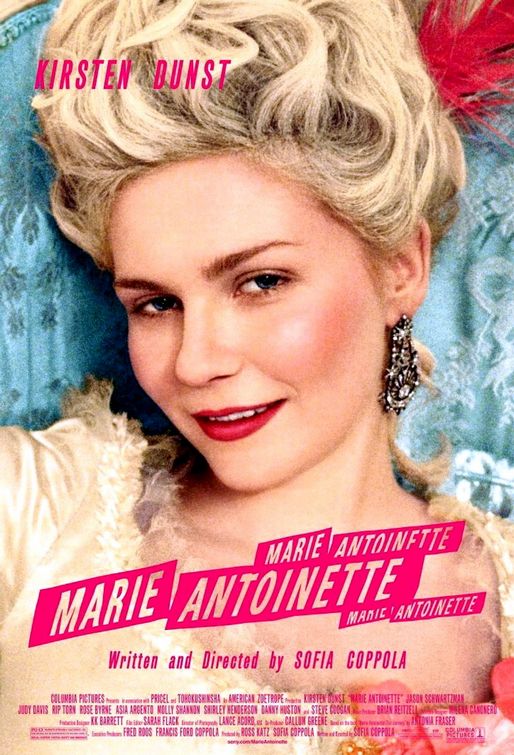
Τετάρτη 25 Απριλίου: Let Them Eat Cake

2006

Sofia Copolla

Marie Antouanette

The image “http://www.impawards.com/2006/posters/marie_antoinette_ver3.jpg” cannot be displayed, because it contains errors.


Marie-Antoinette: This is ridiculous.
Comtesse de Noailles: This, Madame, is Versailles.


http://www.marie-antoinette-association.com/images/jardin.jpg


http://www.marie-antoinette.info/Vogue_Magazine_Pictures_of_Marie_Antoinette.jpg


Marie-Antoinette: I was a queen, and you took away my crown;
a wife, and you killed my husband;
a mother, and you deprived me of my children.
My blood alone remains: take it, but do not make me suffer long.


http://www.strangenewproducts.com/uploaded_images/marie-antoinette-action-figure-765699.jpg


Tuesday, April 3, 2007

Τετάρτη 4 Απριλίου: Τα πάθη


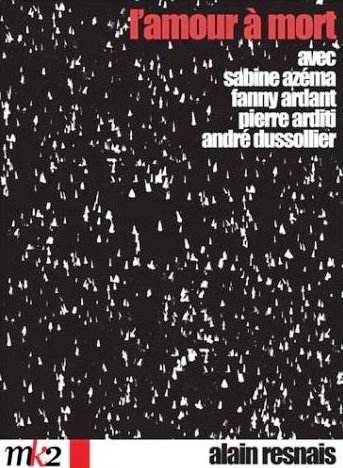
1984
Alain Resnais
L' amour a mort

The image “http://www.shadesofday.com/VMP/lamouramort-poster.jpg” cannot be displayed, because it contains errors.


Κάποιος πεθαίνει. Μετά αναστένεται.


Elisabeth (Sabine Azéma) and Simon (Pierre Arditi) have been together as a couple for only a few months when Simon dies. To everyone’s surprise he revives after a few minutes and appears to be quite healthy again. The couple’s relationship appears to become more intense, but Simon is unable to come to terms with his near-death experience, feeling an irresistible desire to withdraw from life. Their friends, a married couple of Protestant pastors, Judith (Fanny Ardant) and Jérôme (André Dussollier) try to rationalise how Simon and Elisabeth must feel, offering guidance and consolation through theological and philosophical discussions, but the couple are beyond the reach of human understanding or explanation, and the pervasive and persuasive music of ‘the other’, of a love beyond death, exerts an irresistible attraction.

Constantly searching for a new form of expression, expanding on and even defying traditional cinema techniques, Resnais turned to composer Hans Werner Henze to create musical pieces for the film, not as a soundtrack to underline the emotions of the characters, but as scenes in themselves, telling part of the story that cannot be described or illustrated with images – Simon’s death, and the confusion and turmoil of emotions that his near-death experience has filled him with.


http://medias.lefigaro.fr/photos/20060910.WWW000000010_17934_1.jpg

Filmography


Monday, March 26, 2007

Τετάρτη 28 Μαρτίου: Comedy?

The image “http://www.jahsonic.com/Hulot.jpg” cannot be displayed, because it contains errors.

Monday, March 19, 2007

Τρίτη 20 Μαρτίου: Paradise lost

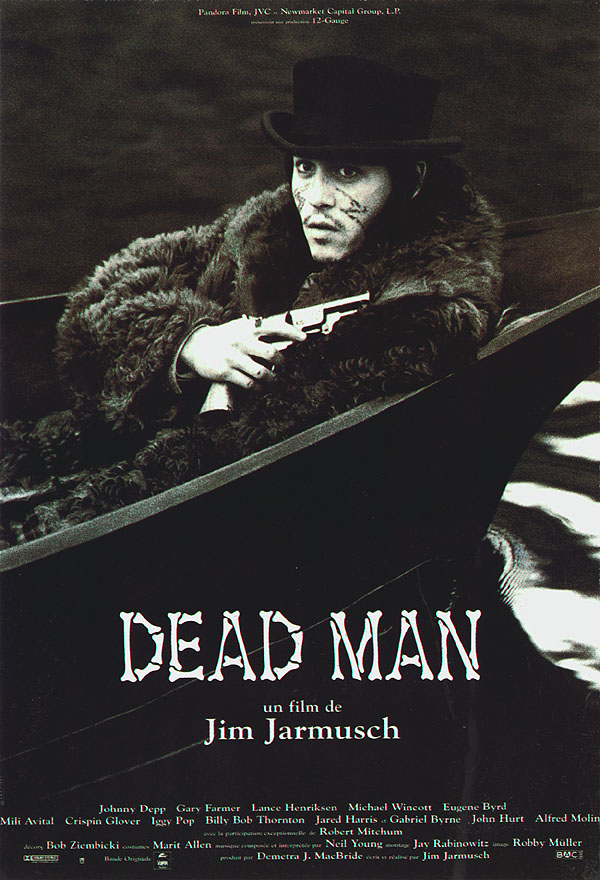
1995
The image “http://bonobo.jones.free.fr/cinema/deadman.jpg” cannot be displayed, because it contains errors.

William Blake
What is your name?

Nobody
My name is Nobody.

William Blake
Excuse me?

Nobody
My name is Exaybachay. He Who Talks Loud, Saying Nothing.

William Blake
He who talks... I thought you said your name was Nobody.

Nobody
I preferred to be called Nobody.


The image “http://jeu.frcd.free.fr/jpg/11s06i02.jpg” cannot be displayed, because it contains errors.

http://www.johnnydeppfan.com/xmovies/dead2.jpg


Minimalism defines the revisionist noir-Western Dead Man, a welcome artistic departure from Jarmusch's increasingly tiresome Downtown sensibility.

William Blake (Johnny Depp), a mild-mannered accountant, travels across the frontier to work for a bookkeeping firm run by a crazed man (Robert Mitchum). But when he arrives at a harsh, alienating town out of a Kafka novel, the job vanishes. Accused of a murder he didn't commit, Blake escapes into the country, where he falls under the spell of a philosophical Indian named Nobody (Gary Farmer), who communes with spirits and treats him as if he were the poet William Blake.

Ambitious, "Dead Man" deals with several complex issues, such as American history, language as a weapon, indigenous culture, and violence. More multi-layered than Jarmusch's former films, the central story takes no precedence over the subplots, which involve a talkative murderer (Michael Wincott) and a Bible-quoting man (Iggy Pop).

Reflecting the zeitgeist in its fixation on morality and transcendence, "Dead Man" stands along other death-obsessed movies, like Mike Figgis' "Leaving Las Vegas" and Tim Robbins' "Dead Man Walking."

Wishing to evoke the feel of a Mizoguchi film, the stylized black-and white cinematography formalizes and distances the landscape. An excellent beginning alternates shots of the changing landscape, the train wheels, and the interior of a passenger car in a rhythm that suggests both tranquility and anxiety--whenever Blake drifts off, people mysteriously disappear. The movie combines Jarmusch's distinctive sense of rhythm with poetic symbolism.

However, Jarmusch's attempts to link Blake's violent, existential experience with William Blake's poetry, a fusion echoed by Nobody, don't go beyond jokiness. The film suggests that "something mysterious" happens to Blake--a vision quest--for, at the end, he gives up his identity.

Many viewers were confused by the mystical, absurdist treatment, uncertain whether the film was no more than a put-on Western. Sharply dividing the critical community, the movie was deemed artistic achievement by the alternative press while dismissed by mainstream reviewers.

Indifferently distributed by Miramax, "Dead Man" failed at the box-office, further tarnishing Jarmusch from his standing as a major indie filmmaker.

Emanuel Levi

Saturday, March 10, 2007

Τετάρτη 14 Μαρτίου: Η ευτυχία χορεύεται


1 9 6 7


Οι

Catherine Deneuve - Fransoise Dorleac

και οι

Gene Kelly * Michel Piccoli * George Chakiris * Danielle Darrieux

στην
μουσικοχορευτική κωμωδία
του

Jacques Demy

σε μουσική του

Michel Legrand


Ο Jacques Demy (1931-1993) υπήρξε ένας από τους πιο αγαπημένους και ταυτόχρονα πιο παραγνωρισμένους σκηνοθέτες της εποχής της Νουβέλ Βαγκ. Xωρίς να προσχωρήσει στην άτυπη ομάδα των Cahiers, στην οποία για ένα σύντομο χρονικό διάστημα «ανήκαν» ο Godard, o Rivette, o Truffaut, ο Chabrol, παρέμεινε στις παρυφές της γαλλικής πρωτοπορίας, γυρίζοντας διεθνείς επιτυχίες –όπως Οι ομπρέλες του Χερβούργου– και ταινίες γοητευτικές, φαντασμαγορικές και αταξινόμητες –όπως Ο μαγικός αυλός ή H τομαρού.

Aρχισε να γυρίζει ταινίες μικρού μήκους από το 1956, επιδεικνύοντας έναν ιδιότυπο ανθρωπισμό, ο οποίος παρέμεινε έως το τέλος ένα από τα χαρακτηριστικά του. Το 1961 γύρισε την πρώτη μεγάλου μήκους ταινία του, τη Λόλα, με πρωταγωνίστρια την Anouk Aimée, σημειώνοντας μια μεγάλη λαϊκή επιτυχία, σε μια εποχή καμπής για τη γαλλική κοινωνία και τον κινηματογράφο. Μερικές από τις επόμενες ταινίες του –Το λιμάνι των αγγέλων, με τη Jeanne Moreau σ’ έναν από τους ωραιότερους ρόλους της, Οι δεσποινίδες του Ροσφόρ, Το φωτομοντέλο– έβγαλαν τον γαλλικό κινηματογράφο από τα στενά όρια της γεωγραφίας του και τον απάλλαξαν από την έμμονη ιδέα της εντοπιότητας.

Ο Jacques Demy, όπως υποστήριξαν άλλωστε πολλές φορές οι συντάκτες των Cahiers du Cinéma, αφομοίωσε με μέτρο και με χάρη την παράδοση του Χόλιγουντ και συναρμολόγησε ένα ολόκληρο κινηματογραφικό είδος, το γαλλικό μιούζικαλ. Με δάνεια από την όπερα, τα ρομάντζα, τα παραμύθια, τα κόμικς, τη λαϊκή κουλτούρα, το σταρ-σίστεμ, την επικαιρότητα, ο Jacques Demy έχτισε έναν ολόκληρο κόσμο, τον κόσμο του, τον οποίον εκθέτει και αναλύει με τρυφερότητα η Agnès Varda στην ταινία της L’ univers de Jacques Demy. Σ’ αυτό τον κόσμο, που εκρήγνυται μέσα σε εκτυφλωτικά χρώματα -ακόμα και στις ασπρόμαυρες ταινίες το φως είναι εκθαμβωτικό- η χαρά της ζωής διαδέχεται την τραγωδία και η λάμψη διαλύει το σκοτάδι: ο Jacques Demy, με τις «τραγουδιστές» ταινίες του προκαλεί ευφορία και πίκρα, γαλήνη και ανησυχία· ένα γνήσιο κινηματογραφικό συναίσθημα.


"Σ’ ένα παραδοσιακό μιούζικαλ υπάρχουν πάντα: ο σεναριογράφος (που γράφει μια ιστορία με μερικές όχι και τόσο συγκεκριμένες υποδείξεις), ο διαλογίστας (που δίνει λεπτομέρειες για κάποιες σκηνές αυτής της ιστορίας και την εξηγεί), ο στιχουργός (που δουλεύει στην ίδια κατεύθυνση) κ.λπ. Eίναι φυσικό, λοιπόν, να υπάρχει μια ασυνέχεια ανάμεσα στην ιστορία, το διάλογο και το τραγούδι, ενώ η ταινία μου είναι εξ ολοκλήρου φτιαγμένη από μένα."


The image “http://www.cahiersducinema.com/IMG/gif/les-demoiselles-de-.gif” cannot be displayed, because it contains errors.

Les Demoiselles de Rochefort

(The Young Girls of Rochefort) (1967)

directed by Jacques Demy and Agnès Varda Frames in this review are taken from the Miramax DVD, released in 2003.


Could life ever be as fanciful and carefree as it is in Les Demoiselles de Rochefort? In this third film of Jacques Demy's romantic trilogy, which he codirected with his wife and longtime collaborator Agnès Varda, France is basking in a ray of pastel colors and joyous song. The troubles of Algeria are behind her, the student protests of 1968 have not yet arrived, and summertime love is in the air. Soldiers have nothing to do but go on practice maneuvers, money is unimportant, and lost loves, well, let's not spoil the ending, shall we?


A thematic trilogy like John Ford's cavalry trilogy, Demy's three films complement each other on several levels. Just superficially, one can pick out a number of elements shared by any two (but not all) of the three films: color, song, sailors, saloons, Americans, fairs, driving around. The most obvious comparison, of course, is to the second film Les Parapluies de Cherbourg (The Umbrellas of Cherbourg), that colorful yet wistful tale of young lovers separated by war and circumstance. The second film in the trilogy was a breakout work, propelling Jacques Demy to the limelight and made an international sensation out of a young Catherine Deneuve, was an ambitious and wildly successful artistic experiment. All the dialog was delivered musically, exploiting the singsong cadences of quotidien French to make everday life magical and significant. Done this way, even a prosaic "Bonsoir, Madeleine" is lyrically sung with welled up emotions of shared experience and almost-sibling love. It's the simplest of stories, but it finds your weakest heartstring and plays tug-of-war with it. A modern-day college-age audience laughs with knowing ridicule (or so they think) at the first scene, becomes utterly absorbed by the third scene, and ends up choking back a lump in the throat at the end. French-speakers have even been observed unabashedly singing "À demain!" to each other, which certainly makes an impression for those waiting for the next showtime.

Rochefort would likely not have happened without Umbrellas, and certainly not have gotten Gene Kelly's involvement. But it is a much less experimental film, and the similarities we notice are due mostly to technique utilized for Umbrellas: bold color design, enthusiastic actors and actresses, an experienced musical team. In theme Demoiselles is more comparable to the less frequently-seen first film in the trilogy, the nonmusical Lola, with its missed meetings, chance encounters, and spiritual musings on love and fate. And while Lola had us laughing at its hero's romantic misfortunes in a luminous black-and-white glow, any setbacks to be found in Rochefort are quickly submerged in its pastel colors, sunny settings, and cheerful score. How can you be unhappy when there's a showstopper song just around the corner? Indeed, even murder becomes a thing to sing about with wide eyes and teasingly unafraid bluster. If LolaUmbrellas beautiful and fragile, then Rochefort makes it all great fun. presented love as capricious and unpredictable, and

Plot


The film wastes no time diving into the world of musicals, following a group of carnies (carnival staff) as they load their trucks and gear onto a sky-bridge. The score moves to a light jazz as they stretch their legs and break out into dance amidst some spectacular overhead shots. Their destination: the Rochefort town square, where a fair is coming up. Overlooking the square is a studio where the sisters Delphine and Solange Garnier (real-life sisters Catherine Deneuve and Françoise Dorléac) teach kids ballet and piano. Their mother Yvonne (Danielle Darrieux) runs a spacious and airy French fry café in the middle of the square, where the two main carnies Étienne and Bill (Chakiris and Grover Dale) hang out.

As befits a good European food establishment, Yvonne's café is the center of activity for the good citizens of Rochefort. There's Pépé (René Bazart) always at a table working on airplane models, grandfatherly Subtil Dutrouz (Henri Crémieux) lamenting the state of the world, and sailor Maxence (Jacques Perrin) singing songs about his idéal féminin. He's a terrible sailor, more of a painter-poet, and can't wait to be demobbed (discharged) from the navy to search for the girl he dreamed up. But as Étienne and Bill point out, Maxence isn't alone in such aspirations.

Indeed, practically everyone is out searching for his/her other half in this film. Hang on. Yvonne reminisces about her long-lost love Simon Dame, lamenting that she had to leave him because she couldn't bear to be called Madame Dame. Unbeknownst to her, Monsieur Dame has set up a music shop and promises to recommend aspiring composer Solange (unaware, of course) to his American composer friend Andy Miller. As Solange goes to pick up her little brother Boubou (Patrick Jeantet) from school, she runs smack dab into none other but Andy Miller (Gene Kelly), who awkwardly begins their acquaintance with the line, "Mademoiselle, votre combinaison dépasse" ("Your slip is showing"). Breathtaken by the encounter, they fail to exchange phone numbers and both part ways unaware of the other person's identity.

Meanwhile, Delphine breaks up her loveless, sex-only relationship with her rich gallery-owner boyfriend Guillaume (Jacques Riberolles). As it happens, one of the images in the gallery is Maxence's painting of his dream girl, the spitting image of Delphine. Alas, Guillaume is unwilling to put his ex-girlfriend in touch with this star-struck painter. Back in the square, Étienne and Bill don't have any luck either, as their girls leave them for sailors with blue eyes ("If only your eyes were blue / I could have died for you"). So they recruit Delphine and Solange to dance a number at their carnival booth. There's a montage of characters singing their songs in preparation for the fair, the big day arrives, and all the threads get neatly wrapped up the morning after. Some are cute, some are macabre, some rely on split-second timing right out of Lola, but the end result is several blissful relationships and a bit of wistfully unfinished optimism mixed in.

Homage


All this sounds more than a bit like West Side Story, and not just because George Chakiris plays a leading supporting character. There's that preclimatic montage of characters singing about their aspirations — the individual leitmotifs don't quite mesh as well as the carefully-arranged parts to "Tonight" in West Side Story, but there's no question that a big day is coming. Much of the dancing self-consciously imitates the Jerome Robbins style, with kicks and spins aplenty. There are even people playing choreographed basketball to music.

It's not limited to West Side Story. The whole film is an homage to the American musical, from the slinky red dresses that the twins wear at the carnival ("Won't we look like whores?" worries Solange, but no, more like Marilyn Monroe in Gentlemen Prefer Blondes) to that statesman of the genre, Gene Kelly, who dances his way from Paris with a wide smile on his face. But the French haven't had time to hone it to perfection, and the dancing in Rochefort is noticeably scrappier than the Hollywood musicals of yore. While the English company providing the dancing in the film is generally well-rehearsed, occasionally you can notice dancers unsure of their footing or looking at the ground for their marks. Any imitation of Jerome Robbins is just that — an imitation, though Chakiris exudes a precision and control that many of the others lack. Gene Kelly is as assured as ever, but even his steps aren't as smoothly choreographed as in his heyday. Some of the actors have obviously not had much experience with lip-syncing either; though most of the majors do quite well, Deneuve in particular having done Umbrellas, Grover Dale in his many scenes with Chakiris stands out with his mouth open too far and his lip sync off by up to a quarter-second.

But if Fred Astaire and Gene Kelly at their peak are a bit out of reach, the lively dancing adds much enthusiasm and energy to Rochefort. And the little numbers performed by the non-dancers have a charm all their own, with the simple choreography keeping our attention focused on the words and music. And what great fun they must've had in writing the lyrics! Lighter in tone than Umbrellas, and with prose available to carry the plot, the lyrics to Rochefort manage to be simultaneously witty and poetic. They laugh at the humor and absurdity of love, and explore the ideal that everyone has a counterpart in the world. Julian More's English translation is written to the cadence of the songs, and preserves the spirit of the French originals right down to the puns and wordplay. My favorite is sentimen-men-men-ments / scandalies-lies-lies-lize (the French word for a lie or falsehood is mensonge). This carries through to the prose as well. "Solange, la clé de sol, et la vole des anges." / "Solange, the key of so and the flight of angels."

The wit extends to the self-references in the film, the cute little touches that make French films of the New Wave so much fun to watch. Rochefort pokes fun at the New Wave itself, as the two carnies Étienne and Bill are referred to as "Jules and Jim" of François Truffaut fame. Composer Michel Legrand finds himself among Louis Armstrong and the greats as the sisters respond to the carnies' request with a musical menu of options. Legrand's score for Rochefort is typical Legrand, sometimes brassy, sometimes melodic, with frequent changes of key and up-and-down scales. It even works its way into the plot, as Solange's unfinished concerto never quite decides what key it's in. And Demy, accused of commercialism for the Esso station in Umbrellas, snubs his nose at his critics with a store selling Kodak film by the square and a large Honda booth at the fair, complete with revolving revving motorcycles.

Happiness


But in-between all the homages and in-jokes is a treatise on love: its serendipity, its capriciousness, its inevitability. The carnies lose their girls, their girls find sailors, but Josette the French-fry stand waitress gets bored with life in Rochefort and joins the troupe with a hankering for adventure. Monsieur Dame promises to connect Solange with Andy Miller, but the twins are unaware of their bonds since they were always away at boarding school when M. Dame was married to Yvonne. Guillaume has a bad-boy streak, shooting guns at paint-filled balloons to create art and driving, but really isn't a mean guy, and wishes her no ill even while toying with her by keeping Maxence away. There's even an axe murder of a former dancer named Lola-Lola by someone she'd spurned in prior life (you'll never guess who, except that you can be Sherlock Holmes and apply the process of elimination).

But murder and heartbreak and missed encounters aside, nothing can spoil the good cheer of France's moment under the sun, certainly not with the characters singing such spirited songs. Much of the film is shot outdoors, and buildings are well-lit, with large windows and bright white walls; the centrally-located French fry café is almost a greenhouse with its floor-to-ceiling windows. Streets are filled with miniskirted girls, smartly dressed soldiers and sailors, and others in various pastel colors to match the buildings. And international affairs don't bother them; Dutrouz may think "there's trouble everywhere, like in '39," but the twins are blissfully unaware of the Gemini (hah!) space program. Even when Bill reflects back on hard times in Cherbourg at a group dinner in Yvonne's restaurant, the gathering can't help but talk in rhyme.

The actors and actresses have a ball too, smiling and laughing and joking throughout the film. An excellent ensemble cast, with much of the supporting cast left to their best character acting due to the large number of roles. What do we know about the carnies' girls, for example, besides their impetuousness? Or Dutrouz, except his fixation on the past? And so they're played that way, the girls' eyes all-agog over the blue-eyed sailors, Dutrouz as a grandfatherly "back in the day" figure. But other roles are fleshed out remarkably well, Maxence the painter-poet being played with gentleness and meditation. Main characters have their own musical themes, leitmotifs which connect them to other characters when played, and which pour out their thoughts when sung. Gene Kelly the Francophile unfortunately has a poor French accent, but his songs are dubbed and much easier to understand. Interestingly, the film provides a striking opportunity to note Catherine Deneuve's qualities — put her next to her sister, herself a talented actress, and somehow Catherine draws the attention. Is it because she's blonde, or because of her softer features, or that ever-present slight curl to her lips that makes her seem both happy and Mona-Lisa mysterious? Well, that's star quality: ineffable, but "I know it when I see it."


RochefortRochefort — the emotional undercurrent is too quickly suppressed by the showy tunes (even the fast-paced argument song between Delphine and Guillaume infuses little anger or resentment; they part ways amicably, and we spend most of the song chuckling at the puns rather than paying attention to what they're saying). But that's somewhat intentional; setbacks can be taken with a smile, for love must prevail at the end. It's a helium-balloon of a fantasy, and we're not so much watching a story as floating through a fantasy world of love and song. For a roller-coaster ride on the emotional train, watch Umbrellas. Rochefort is there for the uplift. presents an idealized world where Maxence can regularly go AWOL to his studio apartment to paint and compose poetry, a whimsical environment where Yvonne gets tired of her last name and tells Simon that she's going to Acapulco. Worries never last for more than a reel, and melancholy is quickly wiped away. Perhaps a little too quickly, as we are reminded at the dinner when Delphine is unhappy with her love life and snaps an angry response to Dutrouz's gentle questioning. Unhappy? Wasn't she just singing? Or perhaps that was everybody else, and we just haven't seen her for a while. That's the only problem with

Technical

The Miramax DVD is very nice, new elements having been created under Varda's supervision after the successful early-1990s Umbrellas rerelease. If anything, these are cleaner and less worn than Umbrellas, due to the lesser popularity of Rochefort. Overall, the colors are soft and pleasant pastels, though bright sunlight and indoor lighting often makes Catherine Deneuve look pale. As with many films of this era, the live-action audio is hissy and muffled compared to the studio-recorded music tracks, but there's little that can done about that.

Camera moves are fairly complex and generally well-planned to showcase the dance sequences. We even have Gene Kelly driving through the streets while reading music, with only an occasional glance at the road, though this is done with a platform rather than with the traditional rear-projection. The film may be a fond artistic homage to Hollywood, but not a technical homage — very little diffusion is used. Gene Kelly was usually shot with diffusion even in his youth due to the small scar on his left cheek; here he looks noticeably older than Simon with whom he's supposed to have gone to school. Interestingly, the large glass windows in Simon Dame's shop seem to be tinted just the right color to match tungsten lighting with outdoor sunshine — the tinting is visible in establishing shots, but from indoors the street looks the right color through the windows and blue through an open door.

Monday, March 5, 2007

Τετάρτη 7 Μαρτίου: Ephemerol


Cameron Vale: [sees that Kim has had a nosebleed] What happened?
Kim Obrist: I was scanned. The woman in the waiting room...
Cameron Vale: She scanned you?
Kim Obrist: No, not her. Her child. Her unborn child scanned me.
Cameron Vale: That's what the Ripe program is. The doctors on the computer list are giving ephemerol to their pregnant patients.
Kim Obrist: I don't understand.
Cameron Vale: Ephemerol. Ephemerol is creating new scanners.


1981

There are 4 billion people on earth. 237 are Scanners.
They have the most terrifying powers ever created...
and they are winning


"I'm a scanner."

Tuesday, February 27, 2007

"I can'τ give you anything but love, baby..."

Θυμηθείτε αυτό το στιχάκι. Είναι το μόνο που μπορεί να καλμάρει τη λεοπάρδαλη (μέσα μας).

Monday, February 26, 2007

Τετάρτη 28 Φεβρουαρίου: Leopard


1938

Howard Hawks
Bringing up Baby


“There’s a pitch in baseball called a screwball, which was perfected by a pitcher named Carl Hubbell back in the 1930s. It’s a pitch with a particular spin that sort of flutters and drops, goes in different directions, and behaves in very unexpected ways... Screwball comedy was unconventional, went in different directions, and behaved in unexpected ways” Andrew Bergman


As is true of many of Howard Hawks' finest films (including the crime film Scarface (1932), Twentieth Century (1934), His Girl Friday (1940), To Have and Have Not (1944), the detective film The Big Sleep (1946), Monkey Business (1952), and Gentlemen Prefer Blondes (1953)), this masterpiece was not nominated for a single Academy Award. Director Peter Bogdanovich paid homage to Hollywood's screwball comedy genre with a loose remake titled What's Up, Doc (1972) starring Barbra Streisand and Ryan O'Neal.

The fast-paced film involves the unlikely relationship of two individuals, portrayed by actress Katharine Hepburn and actor Cary Grant playing against type in a classic "conflict" of the sexes: a mad-cap, scheming, aggressive, impulsive, accident-prone and daffy society heiress, and a bumbling, clumsy, absent-minded, straight, nerdy and stuffy paleontologist from a natural history museum. This was the second of four films co-starring Hepburn and Grant [the others were Sylvia Scarlett (1936), Holiday (1938), and The Philadelphia Story (1940)]. Other characters include a small-town sheriff, a drunken Irish gardener, a big-game hunter, and two Brazilian leopards.

The film's screenplay (by Dudley Nichols and Hagar Wilde) was taken from a Collier's Magazine story authored by Hagar Wilde. [Reportedly, the plot of the antagonistic romance was inspired by the alleged affair that bespectacled director John Ford had with a mismatched Hepburn during the filming of Mary of Scotland (1936).]

This was Katharine Hepburn's only screwball comedy role - it pushed all its characters to the utter extreme, taking them into absurd, embarrassing, and destabilizing, humiliating circumstances (including sex-role reversals, such as frilly cross-dressing and the search for a lost dinosaur bone and a pet leopard named 'Baby') that are wildly and ruthlessly fun. [Grant later played a similar cross-dressing role in Hawks' own I Was a Male War Bride (1949).] The action centers around her eccentric and wild efforts to romantically capture his interest in her and liberate him - with assistance from her dog named "George" (a Scotch terrier named Skippy that played Asta in The Thin Man (1934) series of films and Mr. Smith in The Awful Truth (1937)), her music-loving pet leopard named "Baby" (played by Nissa) and her wealthy, widowed aunt.

Although Hepburn had a brilliant performance in this film, she was an unconventional, independent-spirited performer, and this was her last film for RKO - since she had been infamously labeled 'box-office poison' through most of the 30s. She bought out her contract and returned to Broadway after the film and took a role specifically written for her in playwright Philip Barry's The Philadelphia Story. The play was such a hit that she bought the film rights and made her way back to Hollywood through MGM's successful production of the play - directed by George Cukor.

Tim Dirks


*Για την φιλμογραφία του Hawks βλέπε στις πληροφορίες της πρώτης προβολής της ΣΙΝΕΜΑΤΕΚΑ με το His girl friday

Saturday, February 17, 2007

Τετάρτη 21 Φεβρουαρίου: Invisible boy


2000
Joao Pedro Rodrigues

O fantasma

THE STRANGE DESIR OF SUPERHEROES


Bασανιζόμενος από μια άσβεστη επιθυμία, ο Σέρζιο ζει σ' έναν κόσμο στα μέτρα του. Περνά τις μέρες του ανάμεσα στο φτηνό ενοικιαζόμενο δωμάτιό του, σε ερωτικές συναντήσεις με αγνώστους, και τη δουλειά του: είναι σκουπιδιάρης στα βόρεια της Λισαβόνας. O Σέρζιο βρίσκεται εγκλωβισμένος σε μια κατάσταση παιδική, που τη μοιράζεται μόνο ο Λόρντε, ο σκύλος που φυλάει τη μάντρα των απορριμματοφόρων, και δεν φαίνεται να συνειδητοποιεί τις σκιές που τον περικυκλώνουν: ο έρωτας της Φάτιμα, μιας συναδέλφου του, η παράξενη εγρήγορση ενός αστυνομικού, η διφορούμενη επιθυμία του εργοδηγού. Όμως, μια νύχτα, ο Σέρζι βλέπει το φάντασμα των ονείρων του και ξυπνά με την εμμονή του έρωτα. Σαν υπνωτισμένος, παρακολουθεί τον άντρα, ψαχουλεύει τα σκουπίδια του, εισβάλλει στο σπίτι του. H απόρριψη τον κάνει ν' αναζητήσει καταφύγιο στο χάος, στου κόσμου τα αζήτητα. Eίναι μόνος. Δεν είναι πια τούτου του κόσμου.


Filmmaker: Tell me a bit about how the film evolved.

João Pedro Rodrigues: The film had been in my head for a really long time. And ideas that I had for a long time found a place in this film. Writing the script, presenting it to funding agencies, getting money, and then shooting and completing it, took three years.

Filmmaker: Was the film entirely financed in Portugal?

Rodrigues: It was financed, as are all other Portuguese films, with funds from the Portuguese Film Institute, ICAM (Institute for the Cinema, Audiovisual and Multimedia), and from Portuguese TV. Portuguese film can only exist if it’s funded by the state. It is impossible to get money anywhere else. There is no private investment in film here.

Filmmaker: Did the funding agencies have trouble with the subject matter, because it’s tough. It’s not a cute, gay coming-of-age story. It’s a very dark story.

Rodrigues: To be honest, they liked the script. I had made one short film [Parabéns! (Happy Birthday!), 1997] that, at least here, people talked about. But when I prepared this film, I thought, I have to be honest with myself, I have to think, “What story do I want to tell?” Because the impression you make when you are doing a first feature is very important, because you will be known by that film.

Filmmaker: So much of the film is nonverbal. I’m imagining the script could have been as short as 20 pages. There's very little dialogue.

Rodrigues: Actually it’s longer. I tried to visualize what you see, the actors’ movements, and to put everything into words. Everything is very carefully written. And I rehearsed lots of scenes with a video camera so when I arrived at the moment of shooting, I knew everything. It was like shooting a remake of a film that already existed.

Filmmaker: You worked with a nonprofessional actor as your lead. How did you find him?

Sérgio (Ricardo Meneses) in O Fantasma.

Rodrigues: Not only the lead is nonprofessional, everyone is nonprofessional. I wanted to really have a kind of virginity in the people I found. It was a very long process: we were asking people in the street and in bars, wherever, if they wanted to do a film.

Filmmaker: You were doing that?

Rodrigues: No, other people. I am quite shy. [laughs] I don’t like to go up to people. Also I prefer to get my first impression with the video image, rather than from a real person. Once I selected a few people I thought were possibilities, I went with them into the street and I had them perform simple things, things that had to do with the film.

Filmmaker: Some remarkable performances are being drawn by European directors from nonprofessional actors. For example Bruno Dumont (L'humanite), the Dardenne Brothers, and recently Damien Odoul (Le Souffle).

Rodrigues: My influence was always Robert Bresson. He always worked with nonprofessionals, and I really feel close to his universe.

Filmmaker: By “his universe,” do you mean his particularly Catholic sense of entrapment and liberation?

Rodrigues: No, more the way he shoots and tells stories. What interests me is the narrative in his films. What’s the essence of the story? Can you build a story by destroying it? Mysteries are important when you are doing a film.

Filmmaker: Some filmmakers and novelists want the audience or the reader to complete the story on their own. They don’t want to give the audience all the answers or the whole story. They want the audience to meet the story half way with their own story. Even using nonprofessionals creates mystery — because something in their performance is coming from a place that isn’t trained.


Rodrigues: I agree. For example, when I saw Ricardo’s video casting, I felt he had to play my lead character. It’s the way he looks and moves, of course, but there’s something hidden in him — because when I met him, he was totally different from what I saw on film.

Filmmaker: Did Ricardo understand the character? Did he try to be the character you wrote?

Rodrigues: During the shooting, I didn’t explain the character to him. When I was directing him I wasn’t saying, “You feel like this, you feel like that.” There was a coldness that I was interested in. His performance is very introverted, very sensuous. But what I tried to do was to direct him very precisely. I didn’t want him to build the character. That was my job in the film. I had to build the character through his performance and through images, through what I was shooting and what I was putting inside the frame and what I was leaving outside. Most of the shots are really long. He had lots of different positions that he had to be in at any given moment, and this was very difficult for him because he had no training, and he had to achieve something that looked natural.

Filmmaker: A lot of the film happens at night. There’s a narrative reason — the main character works as a garbage collector on the night shift — but it’s more than that. It’s something to do with our darker side, our nocturnal yearnings.

Rodrigues: I wanted to go towards darkness. And the film, the way it develops, it’s darker and darker. And that was also a challenge, because I just wanted to use natural light. And that is almost an impossible thing to do at night.

We used a very sensitive film stock, Kodak 800 ASA. And it’s really amazing because it’s very, very sensitive. And while I was shooting, my cinematographer was always saying, “We won’t see anything.” And sometimes we shot two versions, one with a little bit more light, and one with just the light that was in the lamps in the streets. And I always chose the one with less light.

João Pedro Rodrigues
Filmmaker: Why?

Rodrigues: Because this character goes towards darkness. In the end he melts into darkness in a black rubber suit. His sexual desires are his body language, the way he moves. In the end, he covers his flesh with the rubber suit and he doesn't desire anymore.

Filmmaker: He is also in touch with something primal from the beginning. His intense relationship with the dog, for example, isn’t the relationship of a human to a dog, it’s the relationship of one animal to another animal.

Rodrigues: I tried to focus on instincts that are of course in every one of us. Not just kissing, but smelling and licking. You don’t usually put that in film.

Filmmaker: The power of the film is that one watches what most people would categorize as sexually deviant or self-destructive behavior and kind of empathizes with it — not so much with the character, who is very anonymous, almost without specificity, but with one’s own potential for deviance or perversion.


Rodrigues: I tried to make the film sensual. In the beginning he is a very biological, organic thing, and in the end he becomes something inorganic — like the waste in the garbage dump.

Perhaps you feel affected not by the character but by the way the story is told, by the pictures I chose to tell this story and the places I chose for this story to happen. Because I already had most of the locations in mind from when I started to write the script. I tried to find the mysteries that are hidden in some places that I know very well in Lisbon.

I really like the abstraction you can get from places by the way you shoot them. For instance, the scene when Sergio finds the policeman inside the car — I shot that on a little country road that is bisected by a freeway. Around Lisbon there are lots and lots of farms. And the freeways sliced up that countryside quality. Sergio has an accent from the north of Portugal, so for me he is someone who is not from Lisbon, he's a country boy who is not in his territory

Filmmaker: And he’s a voyeur, always looking as opposed to belonging. Physically, he’s so agile he can scale walls, like Spider-Man. So the physical world is less something he occupies than something he climbs across or climbs over.

Rodrigues: He’s kind of a superhero. In his mind he can do anything... except speak to people. That is his big drama. The only way he knows how to relate to others is through violence. He takes a man as if he was his prey. And then he doesn’t know what to do with him. And so he leaves him and he is desperate.

Filmmaker: It’s almost like science fiction by the end: in that garbage dump he is like an alien. In Todd Haynes’s film Safe, there’s a similar end where the characters have left the real world behind and are living on another planet that just happens to be ours.

Rodrigues: What I wanted to do was to have that sense of fantasy. Actually, it’s not fantasy, it comes from something really concrete, because it’s a place that we have already seen in the film. It’s like the depot where they always go every night and dump the garbage. It’s not that he goes to another planet suddenly. It looks like that, but he also goes to a place that he has been every night where he knows he can be alone, he knows he can escape. And for me, that was very important, that the fantasy became very concrete, very real. It becomes the banality of life.

Ian Birnie is director of the Film Department at the Los Angeles County Museum of Art.

Friday, February 9, 2007

Δευτέρα 12 Φεβρουαρίου: The Lubitsch touch


Ernst Lubitsch
"To be or not to be"


...μια απ' τις πιο αστείες ταινίες που έχουν γίνει ποτέ.


To Be or Not to Be
Directed by Ernst Lubitsch, 1942

Rating:
by Derek Smith 9/6/04

To Be or Not to Be is not Ernst Lubitsch's funniest or most gratifying film, but its comical, humanistic approach in addressing the nature of Adolph Hitler and the Nazi Party and the value of communal activism in times of dire need may be the most impressive feat of his career. Jack Benny and Carole Lombard play Joseph and Maria Tura, the most famous acting couple in Poland who become involved in the anti-Nazi movement accidentally when their play is shut down and an overzealous lover of Mrs. Tura unknowingly mentions her status to a Nazi spy on his way to Poland. The setup is pure Lubitsch, complete with his uniquely sophisticated style of romantic comedy, critical examining of social rules and morality, and blending of genres and tones to create a compelling and completely original atmosphere for his characters to interact. Given the subject matter, it's not surprising that it's his most serious film and often walks the thin line between brilliance and disaster.

In the early 1940s, Hollywood produced more war films than any other period of time, yet their often blunt and simplistically patriotic tones only secured support for America's involvement. To Be or Not to Be, like Casablanca, the other great film of 1942, takes into account the complexities of war and the necessary sacrifices to bring peace. Within the modern context (at its time of release) of World War II, Lubitsch uses a myriad of hilarious situations and entertaining characters to provide the backdrop to his reflective meditation on the horrors of tyranny as an oppressive force condemning personal and artistic freedom. It's no coincidence he pits the Nazi's against a theater company, though it works as more than a convenient contrast. The success of the Nazi's relies heavily on loyalty to the good of the group, including blindly following orders and acting and reacting as they are directed, just like the actors. Lubitsch never presents them as inhuman, deftly mocking their behavior while always stressing the danger in the thought behind those human faces and the importance of meeting terror with dignity and humanity.

To completely ignore the comic side of To Be or Not to Be would be unfair and like many Lubitsch films, there are few characters that manage to escape his acerbic wit. Benny's uptight, borderline neurotic Joseph Tura is self-involved and his pomposity is met with his wife's acceptance of a handsome, young lover, not because he deserves it, but because his track record indicates he would likely be indifferent. Maria is coy and playfully cruel and while she's more appealing than Joseph, the ingrained arrogance in her demeanor is clearly a shot at the upper class tendency to put appearance and other trivialities above anything real. That Lubitsch can play with themes of marital discord, love circles, and redemption through action rather than words, purely in the short scenes where the sub-plot is allowed to shine is a perfect example of his knack for giving every situation or character a feeling of great importance no matter how much screen time it takes up. The lover, played with proper doses of innocence and arrogance by a barely recognizable Robert Stack, is responsible for creating a rift between Joseph and Maria (or at least making an existing one apparent to them), causing them to reevaluate their marriage until they set their own worries aside in favor of more important tasks. As they work to sabotage the work of Professor Siletsky, the Nazi spy, their true feelings work themselves out in a reaffirmation of love that stems not from honest communication, but the simple realization that the conveniences of their marriage outweigh everything else. Situations such as that one give a small indication of the depth of this film and work as an example of how difficult it is to determine who exactly is the target. It so effortlessly intertwines the comic and the tragic, the love story and the anti-war statement, the honorable actions with the ill-intentioned that every scene builds on existing levels and create new ones. It is the essence of the Lubitsch touch that these qualities are noticeable and indefinable, meaning that his films are often better experienced than discussed. In other words, do yourself a favor and find a copy!


Mini biography

From Ernst Lubitsch's experiences in Sophien Gymnasium (high school) theater, he decided to leave school at the age of sixteen and turn to the stage. He had to compromise with his father and keep the account books for the family tailor business, while he pursued acting in cabarets and music halls at night. In 1911 he joined the Deutsches Theater of famous director/producer/impresario Max Reinhardt. He was able to move up to leading acting roles in a short time. He took an extra job as a handyman while learning silent film acting at Berlin's Bioscope film studios. The next year he launched a film career by appearing in a series of comedies dealing with traditional ethnic Jewish slice-of-life fare. Finding great success in these character roles, Lubitsch turned to broader comedy, then embarked on writing and directing his own films beginning in 1914.

His breakthrough film came in 1918 with Die Augen der Mummie Ma (The Eyes of the Mummy), a tragedy starring future Hollywood star Pola Negri. Also that year he made Carmen, again with Negri, a film that was commercially successful on the international level. His work already characterized his genius for catching the eye as well as the ear in film and not only comedy but historical drama. The year 1919 found Lubitsch with seven films to direct, the two standouts being his lavish Madame DuBarry (1919) with two of his favorite actors Negri again and Emil Jannings, and, especially, his witty parody of the American upper crust, Die Austernprinzessin (The Oyster Princess). "Princess" was the threshold of the trademark Lubitisch style - or the 'Lubitsch Touch', as it became known: sophisticated humor embedded in inspired staging that economically presented a visual synopsis of storyline, scenes, and characters.

World notice brought him to the shores of America to promote his film Das Weib des Pharao (The Loves of Pharaoh) in 1922 and become acquainted with the US thriving film industry. He returned for good to direct new friend and influential star Mary Pickford in his first American hit, Rosita (1923). The Marriage Circle (1924) began the unprecedented run of sophisticated films that mirrored the American scene (though always relocated to foreign or imaginary lands) and all its skewed panorama of the human condition. There was a smooth transition between his silent films for Warner Bros. and the sound movies - usually - at Paramount, now embellished with the flow of speech of Hollywood's greats lending personal nuances to continually heighten the popularity at the box office and the fame of Lubitsch's first rate versatility in crafting a smart film. There was a mix of pioneering musical films and some drama also through the 1930s. The successful formula was such that Paramount made him production manager in 1935, so he could produce his own films and supervise production of others. In 1938 he signed a three year contract with Twentieth Century Fox.

Certainly two of his most beloved films near the end of his career dealt with the political landscape of the World War II ear. He moved to MGM where he directed Greta Garbo and Melvyn Douglas in Ninotchka (1939), the fast-paced comedy of decadent West meets Russian comrades seeking more of life than the mother country can offer. Chock up another one for Lubitsch. During the war he directed perhaps his most beloved comedy - controversial to say the least - dark in a tongue-in-cheek sort of way - but certainly a razor sharp Lubitsch tour de force in smart, precision dialog, scenes, and story. He produced To Be or Not to Be (1942) under his own company Romaine Film Corp. It was a biting satire of Nazi tyranny that also poked fun at Lubitsch's own theater roots with the problems and bickering-but also the triumph-of a threadbare acting troupe in Warsaw during occupation. `Jack Benny's' perfect deadpan humor joined with the zany, vivacious 'Carole Lombard' and a cast of veteran character actors both from Hollywood and Lubitsch's Germany provided all the chemistry needed to make this a classic comedy, as well as fierce statement against the perpetrators of war. The most poignant scene was profoundly so - with Jewish Felix Bressart, another one of Reinhardt's students, as the only Jewish bit player in the company. His supreme hope is a chance to someday play Shylock. He gets his chance as part of a ruse in front of Hitler's Nazi body guards. The famous soliloquy was a bold declaration to the world of Axis brutal inhumanity to man - as focused on the Jewry of Europe.

Lubitsch had a massive heart attack in 1943 after having signed a producer-director's contract with 20th Century-Fox earlier that year and completed Heaven Can Wait. His continued efforts in film were severely stymied but he worked as he could. In late 1944 Otto Preminger, another disciple of Reinhardt's Viennese theater work, took over the direction of A Royal Scandal with Lubitsch named as nominal producer. March of 1947, the year of his passing, brought a special Academy Award (he was nominated three times) to the fading producer/director for his "25-year contribution to motion pictures." At his funeral, two of his fellow directorial emigres from Germany put his epitaph succinctly as they left. Billy Wilder noted: "No more Lubitsch." William Wyler answered: "Worse than that - no more Lubitsch films."


IMDb mini-biography by
William McPeak
Spouse
Vivian Gaye (27 July 1935 - 4 August 1944) (divorced) 1 child
Helene Kraus (August 1922 - 1930) (divorced)

Trivia

1929, discovered actress/operatic singer, Jeanette MacDonald while in New York

Gave the film industry and made famous the phrase, "The Lubitsch Touch" due to his sophisticated wit and style

Brought together one of Hollywood's greatest screen pairing, of Maurice Chevalier and Jeanette MacDonald.

Ernst was known for always playing practical jokes on his film sets.

He directed a "mummy' movie. It wasn't one of the post-Boris Karloff films, but the silent German production "Die Augen der Mumie Ma" (1918).

Retrospective at the 34th Berlin International Film Festival. [1984]

Was vote the 16th Greatst Director of all time by Entertainment Weekly.

Biography in: John Wakeman, editor. "World Film Directors, Volume One, 1890-1945". Pages 692-700. New York: The H.W. Wilson Company, 1987.

He had a daughter, Nicola, with wife Sanya Bezencenet.

The term "MOS" is used, on a slate, when a scene is filmed without sync sound (or any sound). This directive is widely thought to be a homage to Lubitsch who would say, in his thick Berlin accent, that he wished to shoot some footage "mitout sound." "Mit" means "with" in German...ergo...without sound..."mitout sound"- "M-O-S."

Over the years film directors sometimes shoot particular footage silently, without the use of a live microphone. It is known in the industry as shooting "MOS." The origin of who and where it was coined maybe lost in the mists of time but we do know that it was homage to Lubitsch who used to say, in his thick Berlin accent.. "Let's shoot this one 'mit' out sound." Without sound. 'MOS.'

Directed 3 different actors in Oscar-nominated performances: Lewis Stone, Maurice Chevalier and Greta Garbo


Personal quotes

"I let the audience use their imaginations. Can I help it if they misconstrue my suggestions?"

"You could name the great stars of the silent screen who were finished; the great directors gone; the great title writers who were washed up. But remember this, as long as you live: the producers didn't lose a man. They all made the switch. That's where the great talent is."

"I've been to Paris France and I've been to Paris Paramount. Paris Paramount is better."

"Nobody should try to play comedy unless they have a circus going on inside."

"I sometimes make pictures which are not up to my standard, but then it can only be said of a mediocrity that all his work is up to his standard."

"In Hollywood we acquire the finest novels in order to smell the leather bindings."

"There are a thousand ways to point a camera, but really only one."

Thursday, February 1, 2007

Δευτέρα 5 Φεβρουαρίου: Το στρίψιμο της βίδας


1961
Jack Clayton: The Innocents

with Deborah Kerr


Apparitions? Evils? Corruptions?


η καλύτερη μεταφορά στον κινηματογράφο της νουβέλας του Henry James "Το στρίψιμο της βίδας" σε σενάριο του Truman Capote και του William Atchibald, φωτογραφία του Freddie francis ("The Elephant man", "Straight story" "The french lieutenant's woman"), και σκηνοθεσία του Jack Clayton ("The Great Gatsby", "Room at the top"). Ένα μοναδικό αριστούργημα του φανταστικού.


The Innocents is a film that has haunted me ever since I first saw it. Staggering, brilliant, masterful, The Innocents is the Rolls Royce of ghost stories. From the unforgettable camerawork by Freddie Francis to the incisive, beautiful direction by Jack Clayton to the brilliant performance by Deborah Kerr, The Innocents works on a thousand levels. This is a film for anyone who truly wants to see brilliance in its purest form. Any director who wants to make a suspense/horror piece that counts, see this film now. If you can, don't see the pan and scan version -- it was shot in black and white Cinemascope and should be viewed that way


It's about the hands. The answer is in the hands. At last The Innocents (1961) has arrived on DVD. Now we can give this beautifully eerie (and eerily beautiful) British ghost story the repeated viewings it demands and deserves. We can finally match our memories against its layers of teasing images and sounds to explore its more conversation-starting elements. In so doing, we've discovered something we haven't noticed before. The hands. The prayer-clutched hands in the opening credits. Deborah Kerr's prim but high-strung governess repeatedly reaching out and disrupting the roses. A ghoulish garden statue clutching a pair of broken stone hands in its own (before an insect scuttles out of its mouth). Then finally, at the moment where the film's slowly built dread could not squeeze any tighter, a shot of a single hand wrenches everything we think we know and, perhaps, puts the film's famous central question — are the ghosts real? — to rest for good. Our vote for the most intelligent and evocative ghost story ever filmed, Jack Clayton's adaptation of Henry James' The Turn of the Screw is cryptic in ways that force us to find clues insinuated in single lines of dialogue, or in the spaces between the lines. It's a movie that speaks in ellipses, not exclamation points. It sneaks under your skin, subtly and suggestively portraying something sinister and perverse that may exist only in the protagonist's head, but that doesn't mean it can't mess with yours.

The specters that Miss Giddens (Kerr) sees around the country estate might be what she insists they are, the evil shades of Miss Jessup and Peter Quint — the previous governess and her brutish lover — whose wanton sexuality had scandalized the rest of the household before they died on the property under hushed-up circumstances. The longer she loses herself in the house's solitude, and the more she interacts with her strange and precocious charges (Martin Stephens and Pamela Franklin), the more she suspects that the dead couple are "abominations" still corrupting, even possessing, the two orphaned children who adored them. Or is the virginal Miss Giddens living a more earthly tragedy of psychosexual disturbance triggered by her repressed yearning for the children's wealthy gadabout uncle (Michael Redgrave)? He wants nothing to do with his niece and nephew, ever; he's leaving indefinitely for attractions that are "not the sort of amusement one could suitably share with children." The admittedly inexperienced daughter of a reverend, Miss Giddens tells her employer that yes she does have quite the active imagination. Soon after she arrives at the vast estate, she encounters the indistinct but watchful spirits of Miss Jessup and the violent, "handsome" Quint. Is it dead Quint looking down from the top of the house, and who kisses her when the schoolboy Miles presses his mouth to hers with unsettling sensuality? Or are the governess' corseted desires snapping their ties as feverish hallucinations and shockingly lascivious psychosis? The Innocents plays both sides of that polarity, and critics can argue reasonably that the film tries a bit too hard to have it both ways. The screenwriters — Truman Capote chief among them — carefully keep certainty a slippery surface. However, at the jarring climax, a surprising and internally unprecedented P.O.V. shift reveals a hand that (in our opinion) pulls the curtain back to reveal director Clayton's answer. It doesn't diminish the impact of the tragedy that follows, though it does leave us looking forward to watching it all again for revelations and insights more subtly prismed than anything M. Night Shyamalan could pull off on his best days.

The Innocents' reputation has it that the film avoids conventional gimmicks and shock effects. That's not entirely true. A ghostly figure passing through a room, Miss Jessup's disembodied voice ("The children are watching, love me, love me"), and Quint's face approaching a window from the night are touching points with its masterful double-feature contemporary, Robert Wise's The Haunting (another film where a repressed spinster's inner tensions seem to catalyze demonic forces in the house). The inventive and atmospheric black-and-white CinemaScope by photographer Freddie Francis (The Elephant Man, The Straight Story) is as celebrated as the screenplay's Jamesian suggestiveness. In the long history of scary movies is there any shot more memorably chilling than the mournful, black-clad figure standing in the reeds across the lake, shimmering in the heat haze of a summer day or through the veil of an English rain? Together Francis and Clayton use graceful cinematic techniques to do more than just illustrate James' novel. While their imagery of dropping rose petals too pointedly shouts "symbolism," their use of white doves against the morbid and melancholy goings-on brings to mind the European delicacy of Franju's Eyes Without a Face. Deborah Kerr's layered portrayal is arguably the finest in her career. Whether or not Miss Giddens sees real apparitions or is a victim of simply needing a good roll in the four-poster, by not choosing to "play neurotic" Kerr achieves a reality that makes her exactly the right place to anchor our perspective. Add the remarkable performances by the two children, and we're given a ghost story that stays with us not because of spring-loaded frights, but because of how it plucks our nervous system like a violin string.

—Mark Bourne


Thursday, January 25, 2007

Δευτέρα 29 Ιανουαρίου: Στη βοή της καταιγίδος

John Huston: Key Largo
1948-USA-Crime Thriller/Gangster Film


"You don't like it, do you Rocco, the storm?

Show it your gun, why don't you?

If it doesn't stop, shoot it. "


Key Largo is a classic suspense film, and one that succeeds admirably even though most of its action takes place in a single room. Based on Maxwell Anderson’s play, the movie benefits from a smart script, precise direction by John Huston, and an incredible cast. Bogart, Robinson, Bacall, Barrymore, Trevor and the supporting players are all nearly flawless. Yes, we’ve seen Bogart’s character many times before, but nobody’s ever done a better job of playing the cynic who has almost – but not quite – given up on the world. Frank is a character who would fit in as well today as he did in post-war 1948. Same goes with Rocco, a man accustomed to bullying the whole world, but who feels helpless in the face of a raging hurricane.