Tuesday, February 27, 2007
"I can'τ give you anything but love, baby..."

Monday, February 26, 2007
Τετάρτη 28 Φεβρουαρίου: Leopard

1938
Howard Hawks
Bringing up Baby


As is true of many of Howard Hawks' finest films (including the crime film Scarface (1932), Twentieth Century (1934), His Girl Friday (1940), To Have and Have Not (1944), the detective film The Big Sleep (1946), Monkey Business (1952), and Gentlemen Prefer Blondes (1953)), this masterpiece was not nominated for a single Academy Award. Director Peter Bogdanovich paid homage to Hollywood's screwball comedy genre with a loose remake titled What's Up, Doc (1972) starring Barbra Streisand and Ryan O'Neal.
The fast-paced film involves the unlikely relationship of two individuals, portrayed by actress Katharine Hepburn and actor Cary Grant playing against type in a classic "conflict" of the sexes: a mad-cap, scheming, aggressive, impulsive, accident-prone and daffy society heiress, and a bumbling, clumsy, absent-minded, straight, nerdy and stuffy paleontologist from a natural history museum. This was the second of four films co-starring Hepburn and Grant [the others were Sylvia Scarlett (1936), Holiday (1938), and The Philadelphia Story (1940)]. Other characters include a small-town sheriff, a drunken Irish gardener, a big-game hunter, and two Brazilian leopards.
The film's screenplay (by Dudley Nichols and Hagar Wilde) was taken from a Collier's Magazine story authored by Hagar Wilde. [Reportedly, the plot of the antagonistic romance was inspired by the alleged affair that bespectacled director John Ford had with a mismatched Hepburn during the filming of Mary of Scotland (1936).]
This was Katharine Hepburn's only screwball comedy role - it pushed all its characters to the utter extreme, taking them into absurd, embarrassing, and destabilizing, humiliating circumstances (including sex-role reversals, such as frilly cross-dressing and the search for a lost dinosaur bone and a pet leopard named 'Baby') that are wildly and ruthlessly fun. [Grant later played a similar cross-dressing role in Hawks' own I Was a Male War Bride (1949).] The action centers around her eccentric and wild efforts to romantically capture his interest in her and liberate him - with assistance from her dog named "George" (a Scotch terrier named Skippy that played Asta in The Thin Man (1934) series of films and Mr. Smith in The Awful Truth (1937)), her music-loving pet leopard named "Baby" (played by Nissa) and her wealthy, widowed aunt.
Although Hepburn had a brilliant performance in this film, she was an unconventional, independent-spirited performer, and this was her last film for RKO - since she had been infamously labeled 'box-office poison' through most of the 30s. She bought out her contract and returned to Broadway after the film and took a role specifically written for her in playwright Philip Barry's The Philadelphia Story. The play was such a hit that she bought the film rights and made her way back to Hollywood through MGM's successful production of the play - directed by George Cukor.
Tim Dirks

Saturday, February 17, 2007
Τετάρτη 21 Φεβρουαρίου: Invisible boy


 2000
2000Joao Pedro Rodrigues
O fantasma
Bασανιζόμενος από μια άσβεστη επιθυμία, ο Σέρζιο ζει σ' έναν κόσμο στα μέτρα του. Περνά τις μέρες του ανάμεσα στο φτηνό ενοικιαζόμενο δωμάτιό του, σε ερωτικές συναντήσεις με αγνώστους, και τη δουλειά του: είναι σκουπιδιάρης στα βόρεια της Λισαβόνας. O Σέρζιο βρίσκεται εγκλωβισμένος σε μια κατάσταση παιδική, που τη μοιράζεται μόνο ο Λόρντε, ο σκύλος που φυλάει τη μάντρα των απορριμματοφόρων, και δεν φαίνεται να συνειδητοποιεί τις σκιές που τον περικυκλώνουν: ο έρωτας της Φάτιμα, μιας συναδέλφου του, η παράξενη εγρήγορση ενός αστυνομικού, η διφορούμενη επιθυμία του εργοδηγού. Όμως, μια νύχτα, ο Σέρζι βλέπει το φάντασμα των ονείρων του και ξυπνά με την εμμονή του έρωτα. Σαν υπνωτισμένος, παρακολουθεί τον άντρα, ψαχουλεύει τα σκουπίδια του, εισβάλλει στο σπίτι του. H απόρριψη τον κάνει ν' αναζητήσει καταφύγιο στο χάος, στου κόσμου τα αζήτητα. Eίναι μόνος. Δεν είναι πια τούτου του κόσμου.

Filmmaker: Tell me a bit about how the film evolved.
João Pedro Rodrigues: The film had been in my head for a really long time. And ideas that I had for a long time found a place in this film. Writing the script, presenting it to funding agencies, getting money, and then shooting and completing it, took three years.
Filmmaker: Was the film entirely financed in Portugal?
Rodrigues: It was financed, as are all other Portuguese films, with funds from the Portuguese Film Institute, ICAM (Institute for the Cinema, Audiovisual and Multimedia), and from Portuguese TV. Portuguese film can only exist if it’s funded by the state. It is impossible to get money anywhere else. There is no private investment in film here.
Filmmaker: Did the funding agencies have trouble with the subject matter, because it’s tough. It’s not a cute, gay coming-of-age story. It’s a very dark story.
Rodrigues: To be honest, they liked the script. I had made one short film [Parabéns! (Happy Birthday!), 1997] that, at least here, people talked about. But when I prepared this film, I thought, I have to be honest with myself, I have to think, “What story do I want to tell?” Because the impression you make when you are doing a first feature is very important, because you will be known by that film.
Filmmaker: So much of the film is nonverbal. I’m imagining the script could have been as short as 20 pages. There's very little dialogue.
Rodrigues: Actually it’s longer. I tried to visualize what you see, the actors’ movements, and to put everything into words. Everything is very carefully written. And I rehearsed lots of scenes with a video camera so when I arrived at the moment of shooting, I knew everything. It was like shooting a remake of a film that already existed.
Filmmaker: You worked with a nonprofessional actor as your lead. How did you find him?
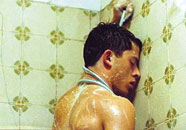 | 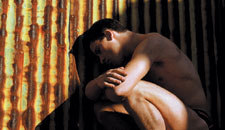 |
| Sérgio (Ricardo Meneses) in O Fantasma. | |
Rodrigues: Not only the lead is nonprofessional, everyone is nonprofessional. I wanted to really have a kind of virginity in the people I found. It was a very long process: we were asking people in the street and in bars, wherever, if they wanted to do a film.
Filmmaker: You were doing that?
Rodrigues: No, other people. I am quite shy. [laughs] I don’t like to go up to people. Also I prefer to get my first impression with the video image, rather than from a real person. Once I selected a few people I thought were possibilities, I went with them into the street and I had them perform simple things, things that had to do with the film.
Filmmaker: Some remarkable performances are being drawn by European directors from nonprofessional actors. For example Bruno Dumont (L'humanite), the Dardenne Brothers, and recently Damien Odoul (Le Souffle).
Rodrigues: My influence was always Robert Bresson. He always worked with nonprofessionals, and I really feel close to his universe.
Filmmaker: By “his universe,” do you mean his particularly Catholic sense of entrapment and liberation?
Rodrigues: No, more the way he shoots and tells stories. What interests me is the narrative in his films. What’s the essence of the story? Can you build a story by destroying it? Mysteries are important when you are doing a film.
Filmmaker: Some filmmakers and novelists want the audience or the reader to complete the story on their own. They don’t want to give the audience all the answers or the whole story. They want the audience to meet the story half way with their own story. Even using nonprofessionals creates mystery — because something in their performance is coming from a place that isn’t trained.
 |  |
| | |
Rodrigues: I agree. For example, when I saw Ricardo’s video casting, I felt he had to play my lead character. It’s the way he looks and moves, of course, but there’s something hidden in him — because when I met him, he was totally different from what I saw on film.
Filmmaker: Did Ricardo understand the character? Did he try to be the character you wrote?
Rodrigues: During the shooting, I didn’t explain the character to him. When I was directing him I wasn’t saying, “You feel like this, you feel like that.” There was a coldness that I was interested in. His performance is very introverted, very sensuous. But what I tried to do was to direct him very precisely. I didn’t want him to build the character. That was my job in the film. I had to build the character through his performance and through images, through what I was shooting and what I was putting inside the frame and what I was leaving outside. Most of the shots are really long. He had lots of different positions that he had to be in at any given moment, and this was very difficult for him because he had no training, and he had to achieve something that looked natural.
Filmmaker: A lot of the film happens at night. There’s a narrative reason — the main character works as a garbage collector on the night shift — but it’s more than that. It’s something to do with our darker side, our nocturnal yearnings.
Rodrigues: I wanted to go towards darkness. And the film, the way it develops, it’s darker and darker. And that was also a challenge, because I just wanted to use natural light. And that is almost an impossible thing to do at night.
We used a very sensitive film stock, Kodak 800 ASA. And it’s really amazing because it’s very, very sensitive. And while I was shooting, my cinematographer was always saying, “We won’t see anything.” And sometimes we shot two versions, one with a little bit more light, and one with just the light that was in the lamps in the streets. And I always chose the one with less light.
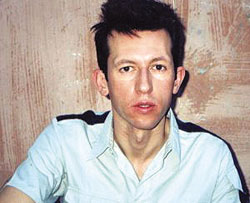 |
| João Pedro Rodrigues |
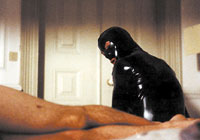
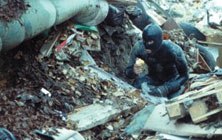
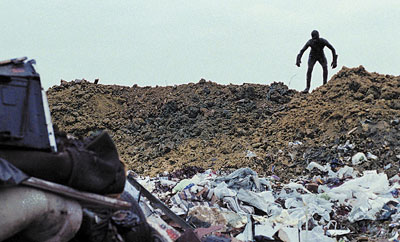
Rodrigues: Because this character goes towards darkness. In the end he melts into darkness in a black rubber suit. His sexual desires are his body language, the way he moves. In the end, he covers his flesh with the rubber suit and he doesn't desire anymore.
Filmmaker: He is also in touch with something primal from the beginning. His intense relationship with the dog, for example, isn’t the relationship of a human to a dog, it’s the relationship of one animal to another animal.
Rodrigues: I tried to focus on instincts that are of course in every one of us. Not just kissing, but smelling and licking. You don’t usually put that in film.
Filmmaker: The power of the film is that one watches what most people would categorize as sexually deviant or self-destructive behavior and kind of empathizes with it — not so much with the character, who is very anonymous, almost without specificity, but with one’s own potential for deviance or perversion.
 |
| |
Rodrigues: I tried to make the film sensual. In the beginning he is a very biological, organic thing, and in the end he becomes something inorganic — like the waste in the garbage dump.
Perhaps you feel affected not by the character but by the way the story is told, by the pictures I chose to tell this story and the places I chose for this story to happen. Because I already had most of the locations in mind from when I started to write the script. I tried to find the mysteries that are hidden in some places that I know very well in Lisbon.
I really like the abstraction you can get from places by the way you shoot them. For instance, the scene when Sergio finds the policeman inside the car — I shot that on a little country road that is bisected by a freeway. Around Lisbon there are lots and lots of farms. And the freeways sliced up that countryside quality. Sergio has an accent from the north of Portugal, so for me he is someone who is not from Lisbon, he's a country boy who is not in his territory
Filmmaker: And he’s a voyeur, always looking as opposed to belonging. Physically, he’s so agile he can scale walls, like Spider-Man. So the physical world is less something he occupies than something he climbs across or climbs over.
Rodrigues: He’s kind of a superhero. In his mind he can do anything... except speak to people. That is his big drama. The only way he knows how to relate to others is through violence. He takes a man as if he was his prey. And then he doesn’t know what to do with him. And so he leaves him and he is desperate.
Filmmaker: It’s almost like science fiction by the end: in that garbage dump he is like an alien. In Todd Haynes’s film Safe, there’s a similar end where the characters have left the real world behind and are living on another planet that just happens to be ours.
Rodrigues: What I wanted to do was to have that sense of fantasy. Actually, it’s not fantasy, it comes from something really concrete, because it’s a place that we have already seen in the film. It’s like the depot where they always go every night and dump the garbage. It’s not that he goes to another planet suddenly. It looks like that, but he also goes to a place that he has been every night where he knows he can be alone, he knows he can escape. And for me, that was very important, that the fantasy became very concrete, very real. It becomes the banality of life.
Ian Birnie is director of the Film Department at the Los Angeles County Museum of Art.Friday, February 9, 2007
Δευτέρα 12 Φεβρουαρίου: The Lubitsch touch

 Ernst Lubitsch
"To be or not to be"

Directed by Ernst Lubitsch, 1942

by Derek Smith 9/6/04

To Be or Not to Be is not Ernst Lubitsch's funniest or most gratifying film, but its comical, humanistic approach in addressing the nature of Adolph Hitler and the Nazi Party and the value of communal activism in times of dire need may be the most impressive feat of his career. Jack Benny and Carole Lombard play Joseph and Maria Tura, the most famous acting couple in

In the early 1940s,


- Mini biography
From Ernst Lubitsch's experiences in Sophien Gymnasium (high school) theater, he decided to leave school at the age of sixteen and turn to the stage. He had to compromise with his father and keep the account books for the family tailor business, while he pursued acting in cabarets and music halls at night. In 1911 he joined the Deutsches Theater of famous director/producer/impresario Max Reinhardt. He was able to move up to leading acting roles in a short time. He took an extra job as a handyman while learning silent film acting at Berlin's Bioscope film studios. The next year he launched a film career by appearing in a series of comedies dealing with traditional ethnic Jewish slice-of-life fare. Finding great success in these character roles, Lubitsch turned to broader comedy, then embarked on writing and directing his own films beginning in 1914.
His breakthrough film came in 1918 with Die Augen der Mummie Ma (The Eyes of the Mummy), a tragedy starring future Hollywood star Pola Negri. Also that year he made Carmen, again with Negri, a film that was commercially successful on the international level. His work already characterized his genius for catching the eye as well as the ear in film and not only comedy but historical drama. The year 1919 found Lubitsch with seven films to direct, the two standouts being his lavish Madame DuBarry (1919) with two of his favorite actors Negri again and Emil Jannings, and, especially, his witty parody of the American upper crust, Die Austernprinzessin (The Oyster Princess). "Princess" was the threshold of the trademark Lubitisch style - or the 'Lubitsch Touch', as it became known: sophisticated humor embedded in inspired staging that economically presented a visual synopsis of storyline, scenes, and characters.
World notice brought him to the shores of America to promote his film Das Weib des Pharao (The Loves of Pharaoh) in 1922 and become acquainted with the US thriving film industry. He returned for good to direct new friend and influential star Mary Pickford in his first American hit, Rosita (1923). The Marriage Circle (1924) began the unprecedented run of sophisticated films that mirrored the American scene (though always relocated to foreign or imaginary lands) and all its skewed panorama of the human condition. There was a smooth transition between his silent films for Warner Bros. and the sound movies - usually - at Paramount, now embellished with the flow of speech of Hollywood's greats lending personal nuances to continually heighten the popularity at the box office and the fame of Lubitsch's first rate versatility in crafting a smart film. There was a mix of pioneering musical films and some drama also through the 1930s. The successful formula was such that Paramount made him production manager in 1935, so he could produce his own films and supervise production of others. In 1938 he signed a three year contract with Twentieth Century Fox.
Certainly two of his most beloved films near the end of his career dealt with the political landscape of the World War II ear. He moved to MGM where he directed Greta Garbo and Melvyn Douglas in Ninotchka (1939), the fast-paced comedy of decadent West meets Russian comrades seeking more of life than the mother country can offer. Chock up another one for Lubitsch. During the war he directed perhaps his most beloved comedy - controversial to say the least - dark in a tongue-in-cheek sort of way - but certainly a razor sharp Lubitsch tour de force in smart, precision dialog, scenes, and story. He produced To Be or Not to Be (1942) under his own company Romaine Film Corp. It was a biting satire of Nazi tyranny that also poked fun at Lubitsch's own theater roots with the problems and bickering-but also the triumph-of a threadbare acting troupe in Warsaw during occupation. `Jack Benny's' perfect deadpan humor joined with the zany, vivacious 'Carole Lombard' and a cast of veteran character actors both from Hollywood and Lubitsch's Germany provided all the chemistry needed to make this a classic comedy, as well as fierce statement against the perpetrators of war. The most poignant scene was profoundly so - with Jewish Felix Bressart, another one of Reinhardt's students, as the only Jewish bit player in the company. His supreme hope is a chance to someday play Shylock. He gets his chance as part of a ruse in front of Hitler's Nazi body guards. The famous soliloquy was a bold declaration to the world of Axis brutal inhumanity to man - as focused on the Jewry of Europe.
Lubitsch had a massive heart attack in 1943 after having signed a producer-director's contract with 20th Century-Fox earlier that year and completed Heaven Can Wait. His continued efforts in film were severely stymied but he worked as he could. In late 1944 Otto Preminger, another disciple of Reinhardt's Viennese theater work, took over the direction of A Royal Scandal with Lubitsch named as nominal producer. March of 1947, the year of his passing, brought a special Academy Award (he was nominated three times) to the fading producer/director for his "25-year contribution to motion pictures." At his funeral, two of his fellow directorial emigres from Germany put his epitaph succinctly as they left. Billy Wilder noted: "No more Lubitsch." William Wyler answered: "Worse than that - no more Lubitsch films."- IMDb mini-biography by
- William McPeak
- Spouse
Vivian Gaye (27 July 1935 - 4 August 1944) (divorced) 1 child Helene Kraus (August 1922 - 1930) (divorced) - Trivia
1929, discovered actress/operatic singer, Jeanette MacDonald while in New York
Gave the film industry and made famous the phrase, "The Lubitsch Touch" due to his sophisticated wit and style
Brought together one of Hollywood's greatest screen pairing, of Maurice Chevalier and Jeanette MacDonald.
Ernst was known for always playing practical jokes on his film sets.
He directed a "mummy' movie. It wasn't one of the post-Boris Karloff films, but the silent German production "Die Augen der Mumie Ma" (1918).
Retrospective at the 34th Berlin International Film Festival. [1984]
Was vote the 16th Greatst Director of all time by Entertainment Weekly.
Biography in: John Wakeman, editor. "World Film Directors, Volume One, 1890-1945". Pages 692-700. New York: The H.W. Wilson Company, 1987.
He had a daughter, Nicola, with wife Sanya Bezencenet.
The term "MOS" is used, on a slate, when a scene is filmed without sync sound (or any sound). This directive is widely thought to be a homage to Lubitsch who would say, in his thick Berlin accent, that he wished to shoot some footage "mitout sound." "Mit" means "with" in German...ergo...without sound..."mitout sound"- "M-O-S."
Over the years film directors sometimes shoot particular footage silently, without the use of a live microphone. It is known in the industry as shooting "MOS." The origin of who and where it was coined maybe lost in the mists of time but we do know that it was homage to Lubitsch who used to say, in his thick Berlin accent.. "Let's shoot this one 'mit' out sound." Without sound. 'MOS.'
Directed 3 different actors in Oscar-nominated performances: Lewis Stone, Maurice Chevalier and Greta Garbo
- Personal quotes
"I let the audience use their imaginations. Can I help it if they misconstrue my suggestions?"
"You could name the great stars of the silent screen who were finished; the great directors gone; the great title writers who were washed up. But remember this, as long as you live: the producers didn't lose a man. They all made the switch. That's where the great talent is."
"I've been to Paris France and I've been to Paris Paramount. Paris Paramount is better."
"Nobody should try to play comedy unless they have a circus going on inside."
"I sometimes make pictures which are not up to my standard, but then it can only be said of a mediocrity that all his work is up to his standard."
"In Hollywood we acquire the finest novels in order to smell the leather bindings."
"There are a thousand ways to point a camera, but really only one."
Thursday, February 1, 2007
Δευτέρα 5 Φεβρουαρίου: Το στρίψιμο της βίδας


1961
Jack Clayton: The Innocents
with Deborah Kerr
Apparitions? Evils? Corruptions?
η καλύτερη μεταφορά στον κινηματογράφο της νουβέλας του Henry James "Το στρίψιμο της βίδας" σε σενάριο του Truman Capote και του William Atchibald, φωτογραφία του Freddie francis ("The Elephant man", "Straight story" "The french lieutenant's woman"), και σκηνοθεσία του Jack Clayton ("The Great Gatsby", "Room at the top"). Ένα μοναδικό αριστούργημα του φανταστικού.


It's about the hands. The answer is in the hands. At last The Innocents (1961) has arrived on DVD. Now we can give this beautifully eerie (and eerily beautiful) British ghost story the repeated viewings it demands and deserves. We can finally match our memories against its layers of teasing images and sounds to explore its more conversation-starting elements. In so doing, we've discovered something we haven't noticed before. The hands. The prayer-clutched hands in the opening credits. Deborah Kerr's prim but high-strung governess repeatedly reaching out and disrupting the roses. A ghoulish garden statue clutching a pair of broken stone hands in its own (before an insect scuttles out of its mouth). Then finally, at the moment where the film's slowly built dread could not squeeze any tighter, a shot of a single hand wrenches everything we think we know and, perhaps, puts the film's famous central question — are the ghosts real? — to rest for good. Our vote for the most intelligent and evocative ghost story ever filmed, Jack Clayton's adaptation of Henry James' The Turn of the Screw is cryptic in ways that force us to find clues insinuated in single lines of dialogue, or in the spaces between the lines. It's a movie that speaks in ellipses, not exclamation points. It sneaks under your skin, subtly and suggestively portraying something sinister and perverse that may exist only in the protagonist's head, but that doesn't mean it can't mess with yours.
The specters that Miss Giddens (Kerr) sees around the country estate might be what she insists they are, the evil shades of Miss Jessup and Peter Quint — the previous governess and her brutish lover — whose wanton sexuality had scandalized the rest of the household before they died on the property under hushed-up circumstances. The longer she loses herself in the house's solitude, and the more she interacts with her strange and precocious charges (Martin Stephens and Pamela Franklin), the more she suspects that the dead couple are "abominations" still corrupting, even possessing, the two orphaned children who adored them. Or is the virginal Miss Giddens living a more earthly tragedy of psychosexual disturbance triggered by her repressed yearning for the children's wealthy gadabout uncle (Michael Redgrave)? He wants nothing to do with his niece and nephew, ever; he's leaving indefinitely for attractions that are "not the sort of amusement one could suitably share with children." The admittedly inexperienced daughter of a reverend, Miss Giddens tells her employer that yes she does have quite the active imagination. Soon after she arrives at the vast estate, she encounters the indistinct but watchful spirits of Miss Jessup and the violent, "handsome" Quint. Is it dead Quint looking down from the top of the house, and who kisses her when the schoolboy Miles presses his mouth to hers with unsettling sensuality? Or are the governess' corseted desires snapping their ties as feverish hallucinations and shockingly lascivious psychosis? The Innocents plays both sides of that polarity, and critics can argue reasonably that the film tries a bit too hard to have it both ways. The screenwriters — Truman Capote chief among them — carefully keep certainty a slippery surface. However, at the jarring climax, a surprising and internally unprecedented P.O.V. shift reveals a hand that (in our opinion) pulls the curtain back to reveal director Clayton's answer. It doesn't diminish the impact of the tragedy that follows, though it does leave us looking forward to watching it all again for revelations and insights more subtly prismed than anything M. Night Shyamalan could pull off on his best days.
The Innocents' reputation has it that the film avoids conventional gimmicks and shock effects. That's not entirely true. A ghostly figure passing through a room, Miss Jessup's disembodied voice ("The children are watching, love me, love me"), and Quint's face approaching a window from the night are touching points with its masterful double-feature contemporary, Robert Wise's The Haunting (another film where a repressed spinster's inner tensions seem to catalyze demonic forces in the house). The inventive and atmospheric black-and-white CinemaScope by photographer Freddie Francis (The Elephant Man, The Straight Story) is as celebrated as the screenplay's Jamesian suggestiveness. In the long history of scary movies is there any shot more memorably chilling than the mournful, black-clad figure standing in the reeds across the lake, shimmering in the heat haze of a summer day or through the veil of an English rain? Together Francis and Clayton use graceful cinematic techniques to do more than just illustrate James' novel. While their imagery of dropping rose petals too pointedly shouts "symbolism," their use of white doves against the morbid and melancholy goings-on brings to mind the European delicacy of Franju's Eyes Without a Face. Deborah Kerr's layered portrayal is arguably the finest in her career. Whether or not Miss Giddens sees real apparitions or is a victim of simply needing a good roll in the four-poster, by not choosing to "play neurotic" Kerr achieves a reality that makes her exactly the right place to anchor our perspective. Add the remarkable performances by the two children, and we're given a ghost story that stays with us not because of spring-loaded frights, but because of how it plucks our nervous system like a violin string.
—Mark Bourne