

 2000
2000Joao Pedro Rodrigues
O fantasma
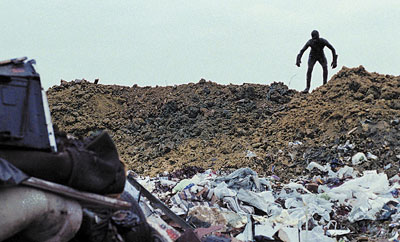
Bασανιζόμενος από μια άσβεστη επιθυμία, ο Σέρζιο ζει σ' έναν κόσμο στα μέτρα του. Περνά τις μέρες του ανάμεσα στο φτηνό ενοικιαζόμενο δωμάτιό του, σε ερωτικές συναντήσεις με αγνώστους, και τη δουλειά του: είναι σκουπιδιάρης στα βόρεια της Λισαβόνας. O Σέρζιο βρίσκεται εγκλωβισμένος σε μια κατάσταση παιδική, που τη μοιράζεται μόνο ο Λόρντε, ο σκύλος που φυλάει τη μάντρα των απορριμματοφόρων, και δεν φαίνεται να συνειδητοποιεί τις σκιές που τον περικυκλώνουν: ο έρωτας της Φάτιμα, μιας συναδέλφου του, η παράξενη εγρήγορση ενός αστυνομικού, η διφορούμενη επιθυμία του εργοδηγού. Όμως, μια νύχτα, ο Σέρζι βλέπει το φάντασμα των ονείρων του και ξυπνά με την εμμονή του έρωτα. Σαν υπνωτισμένος, παρακολουθεί τον άντρα, ψαχουλεύει τα σκουπίδια του, εισβάλλει στο σπίτι του. H απόρριψη τον κάνει ν' αναζητήσει καταφύγιο στο χάος, στου κόσμου τα αζήτητα. Eίναι μόνος. Δεν είναι πια τούτου του κόσμου.

Filmmaker: Tell me a bit about how the film evolved.
João Pedro Rodrigues: The film had been in my head for a really long time. And ideas that I had for a long time found a place in this film. Writing the script, presenting it to funding agencies, getting money, and then shooting and completing it, took three years.
Filmmaker: Was the film entirely financed in Portugal?
Rodrigues: It was financed, as are all other Portuguese films, with funds from the Portuguese Film Institute, ICAM (Institute for the Cinema, Audiovisual and Multimedia), and from Portuguese TV. Portuguese film can only exist if it’s funded by the state. It is impossible to get money anywhere else. There is no private investment in film here.
Filmmaker: Did the funding agencies have trouble with the subject matter, because it’s tough. It’s not a cute, gay coming-of-age story. It’s a very dark story.
Rodrigues: To be honest, they liked the script. I had made one short film [Parabéns! (Happy Birthday!), 1997] that, at least here, people talked about. But when I prepared this film, I thought, I have to be honest with myself, I have to think, “What story do I want to tell?” Because the impression you make when you are doing a first feature is very important, because you will be known by that film.
Filmmaker: So much of the film is nonverbal. I’m imagining the script could have been as short as 20 pages. There's very little dialogue.
Rodrigues: Actually it’s longer. I tried to visualize what you see, the actors’ movements, and to put everything into words. Everything is very carefully written. And I rehearsed lots of scenes with a video camera so when I arrived at the moment of shooting, I knew everything. It was like shooting a remake of a film that already existed.
Filmmaker: You worked with a nonprofessional actor as your lead. How did you find him?
 | 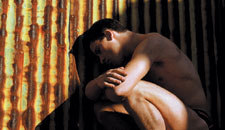 |
| Sérgio (Ricardo Meneses) in O Fantasma. | |
Rodrigues: Not only the lead is nonprofessional, everyone is nonprofessional. I wanted to really have a kind of virginity in the people I found. It was a very long process: we were asking people in the street and in bars, wherever, if they wanted to do a film.
Filmmaker: You were doing that?
Rodrigues: No, other people. I am quite shy. [laughs] I don’t like to go up to people. Also I prefer to get my first impression with the video image, rather than from a real person. Once I selected a few people I thought were possibilities, I went with them into the street and I had them perform simple things, things that had to do with the film.
Filmmaker: Some remarkable performances are being drawn by European directors from nonprofessional actors. For example Bruno Dumont (L'humanite), the Dardenne Brothers, and recently Damien Odoul (Le Souffle).
Rodrigues: My influence was always Robert Bresson. He always worked with nonprofessionals, and I really feel close to his universe.
Filmmaker: By “his universe,” do you mean his particularly Catholic sense of entrapment and liberation?
Rodrigues: No, more the way he shoots and tells stories. What interests me is the narrative in his films. What’s the essence of the story? Can you build a story by destroying it? Mysteries are important when you are doing a film.
Filmmaker: Some filmmakers and novelists want the audience or the reader to complete the story on their own. They don’t want to give the audience all the answers or the whole story. They want the audience to meet the story half way with their own story. Even using nonprofessionals creates mystery — because something in their performance is coming from a place that isn’t trained.
 |  |
| | |
Rodrigues: I agree. For example, when I saw Ricardo’s video casting, I felt he had to play my lead character. It’s the way he looks and moves, of course, but there’s something hidden in him — because when I met him, he was totally different from what I saw on film.
Filmmaker: Did Ricardo understand the character? Did he try to be the character you wrote?
Rodrigues: During the shooting, I didn’t explain the character to him. When I was directing him I wasn’t saying, “You feel like this, you feel like that.” There was a coldness that I was interested in. His performance is very introverted, very sensuous. But what I tried to do was to direct him very precisely. I didn’t want him to build the character. That was my job in the film. I had to build the character through his performance and through images, through what I was shooting and what I was putting inside the frame and what I was leaving outside. Most of the shots are really long. He had lots of different positions that he had to be in at any given moment, and this was very difficult for him because he had no training, and he had to achieve something that looked natural.
Filmmaker: A lot of the film happens at night. There’s a narrative reason — the main character works as a garbage collector on the night shift — but it’s more than that. It’s something to do with our darker side, our nocturnal yearnings.
Rodrigues: I wanted to go towards darkness. And the film, the way it develops, it’s darker and darker. And that was also a challenge, because I just wanted to use natural light. And that is almost an impossible thing to do at night.
We used a very sensitive film stock, Kodak 800 ASA. And it’s really amazing because it’s very, very sensitive. And while I was shooting, my cinematographer was always saying, “We won’t see anything.” And sometimes we shot two versions, one with a little bit more light, and one with just the light that was in the lamps in the streets. And I always chose the one with less light.
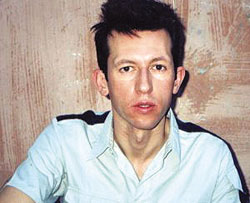 |
| João Pedro Rodrigues |
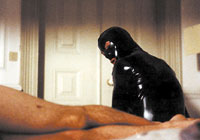
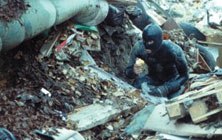
Rodrigues: Because this character goes towards darkness. In the end he melts into darkness in a black rubber suit. His sexual desires are his body language, the way he moves. In the end, he covers his flesh with the rubber suit and he doesn't desire anymore.
Filmmaker: He is also in touch with something primal from the beginning. His intense relationship with the dog, for example, isn’t the relationship of a human to a dog, it’s the relationship of one animal to another animal.
Rodrigues: I tried to focus on instincts that are of course in every one of us. Not just kissing, but smelling and licking. You don’t usually put that in film.
Filmmaker: The power of the film is that one watches what most people would categorize as sexually deviant or self-destructive behavior and kind of empathizes with it — not so much with the character, who is very anonymous, almost without specificity, but with one’s own potential for deviance or perversion.
 |
| |
Rodrigues: I tried to make the film sensual. In the beginning he is a very biological, organic thing, and in the end he becomes something inorganic — like the waste in the garbage dump.
Perhaps you feel affected not by the character but by the way the story is told, by the pictures I chose to tell this story and the places I chose for this story to happen. Because I already had most of the locations in mind from when I started to write the script. I tried to find the mysteries that are hidden in some places that I know very well in Lisbon.
I really like the abstraction you can get from places by the way you shoot them. For instance, the scene when Sergio finds the policeman inside the car — I shot that on a little country road that is bisected by a freeway. Around Lisbon there are lots and lots of farms. And the freeways sliced up that countryside quality. Sergio has an accent from the north of Portugal, so for me he is someone who is not from Lisbon, he's a country boy who is not in his territory
Filmmaker: And he’s a voyeur, always looking as opposed to belonging. Physically, he’s so agile he can scale walls, like Spider-Man. So the physical world is less something he occupies than something he climbs across or climbs over.
Rodrigues: He’s kind of a superhero. In his mind he can do anything... except speak to people. That is his big drama. The only way he knows how to relate to others is through violence. He takes a man as if he was his prey. And then he doesn’t know what to do with him. And so he leaves him and he is desperate.
Filmmaker: It’s almost like science fiction by the end: in that garbage dump he is like an alien. In Todd Haynes’s film Safe, there’s a similar end where the characters have left the real world behind and are living on another planet that just happens to be ours.
Rodrigues: What I wanted to do was to have that sense of fantasy. Actually, it’s not fantasy, it comes from something really concrete, because it’s a place that we have already seen in the film. It’s like the depot where they always go every night and dump the garbage. It’s not that he goes to another planet suddenly. It looks like that, but he also goes to a place that he has been every night where he knows he can be alone, he knows he can escape. And for me, that was very important, that the fantasy became very concrete, very real. It becomes the banality of life.
Ian Birnie is director of the Film Department at the Los Angeles County Museum of Art.

No comments:
Post a Comment